Alliant Energy — Renewable Energy Solutions
0800 088 4286Get a Quote →

Solar for homes · Lancashire & North West

Solar Panel Installation in Lancashire — Own Your Electricity

MCS-registered solar panel installation across Lancashire and the North West. Fixed-price packages from £5,999 including battery storage and. A correctly sized system covers 65–90% of a typical household's electricity use and earns income through the Smart Export Guarantee.

  • MCS Registered
  • TrustMark Registered
  • NICEIC & NAPIT Approved
  • RECC Registered
  • Up to 30-year warranty
  • 5-Year Workmanship WarrantyAlliant's own guarantee on the quality of our installation and labour — separate from, and in addition to, the manufacturer's product and performance warranties (up to 30 years on solar panels), which cover the equipment itself.

*The 5-Year Workmanship Warranty covers Alliant's own installation and labour — distinct from the manufacturer's product and performance warranties (up to 30 years on panels), which cover the equipment itself.

Solar panel installation in Lancashire costs from £5,999 fully installed — including battery storage, scaffolding and — when you use an MCS-registered installer like Alliant Energy. A correctly sized system covers 65–90% of a typical household's electricity use and earns additional income through the Smart Export Guarantee.

Key takeaways

  • Fixed packages from £5,999 (6 panels + 5.76kWh battery) to £9,000 (12 panels + 11kWh battery) — until 31 March 2027.
  • Lancashire receives 2.7 peak sun hours/day on average; a 4kW system generates 3,200–3,500 kWh/year — sufficient for 65–90% of household electricity (PVGIS data).
  • Over 2 million UK homes now have solar panels, with a record 267,032 rooftop installs completed in 2025 — up 31% on the previous record.
  • Solar adds an average 6.1–7.1% to UK property values (2024 Swansea University analysis of 1.5 million transactions).
  • Lancashire homeowners may qualify for free installation via the Warm Homes Local Grant — Alliant handles the application.
  • Best SEG export rate currently 25p/kWh flat (Good Energy); up to 32p/kWh peak with the Levelise hub on Octopus Intelligent Flux.
  • Typical payback: 5.5–6.5 years on Alliant's 12-panel package, before grants.

Why now

Why are Lancashire homeowners switching to solar in 2026?

The electricity bill shock of 2022–2023 never fully reversed. Under the Q3 2026 Ofgem energy price cap, the standard unit rate in the North West sits at approximately 25.2p/kWh — more than 50% above the pre-2022 norm of 16p/kWh. A typical Lancashire semi-detached home consuming 3,500 kWh per year now spends around £880 annually on electricity alone, even on a direct debit tariff.

Solar panels address this directly. A correctly sized system generates electricity from your own roof at an effective cost well under 5p/kWh over its 25-year life — and any surplus gets paid back to you via the Smart Export Guarantee. Add battery storage and the Levelise smart hub, and your system can also buy cheap overnight electricity and sell it back during peak price windows — turning your home's energy setup from a cost into an income stream.

Nationally, the trend is accelerating. More than 2 million UK homes now have solar panels, and MCS recorded a record 267,032 rooftop installations in 2025 — 31% above the previous record set during the original Feed-in Tariff era. In Lancashire, the Warm Homes Local Grant has further accelerated adoption by making fully-funded installations available to eligible households for the first time.

2M+

UK homes with solar panels

pv-magazine / gov.uk, 2026

267,032

Record UK rooftop installs in 2025

MCS, 2026

25.2p

NW electricity unit rate, Q3 2026

Ofgem price cap

6.1–7.1%

Average property value uplift from solar

Swansea Uni, 1.5M transactions, 2024

2.7 hrs

Peak sun hours/day in Nelson, Lancashire

PVGIS EU data, 53.8°N

£13.2bn

UK Warm Homes Plan commitment

DESNZ, 2024

The package

What's included in every Alliant residential solar package?

Every Alliant residential installation uses the same core equipment stack, regardless of system size:

  • DMEGC 465W monocrystalline PERC panels — tier-1 manufacturer, 30-year product and performance warranty, less than 0.4% annual degradation rate, meaning panels produce at least 88% of day-one output after 30 years
  • Fox ESS H3 3.7kW hybrid inverter — converts DC power from the panels to AC power for your home, manages grid export for Smart Export Guarantee metering, and communicates with the Levelise hub in real time
  • Levelise smart hub — battery optimisation software that adds grid arbitrage, SEG maximisation, and National Grid Demand Flexibility Service income on top of standard battery storage
  • 5.76kWh or 11kWh battery pack (package dependent)
  • Full scaffolding to one roof elevation
  • MCS-registered design and installation by Alliant's in-house engineers
  • DNO notification to Electricity North West (G98 or G99) — handled entirely by Alliant
  • Commissioning, monitoring app setup and system handover
  • — valid on all residential solar PV until 31 March 2027
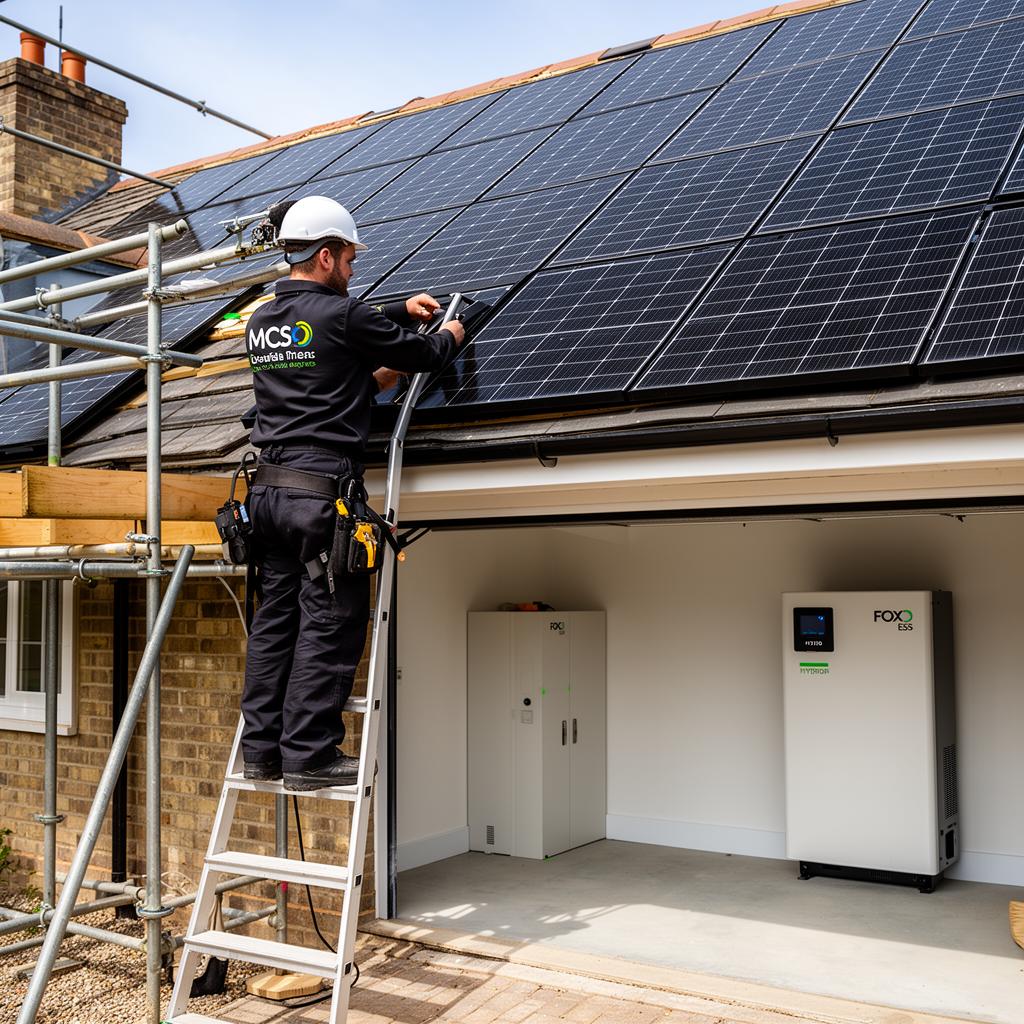
MCS-registered Alliant Energy engineer fitting solar panels with a Fox ESS hybrid inverter and battery in Lancashire

The equipment

What hardware does Alliant Energy install?

Alliant Energy installs DMEGC 465W monocrystalline solar panels — a tier-1 manufacturer with a 30-year product warranty and independently verified performance degradation of less than 0.4% per year, meaning your panels still produce at least 88% of day-one output after 30 years. DMEGC panels use PERC cell technology (Passivated Emitter and Rear Cell), which increases efficiency by capturing reflected light from the rear of each cell.

Each panel is mounted using Clenergy tilt-frame racking rated to BS 6399-1 wind-load standards, with Fastensol flashings providing a watertight roof seal. The Fox ESS H3 hybrid inverter converts DC power from the panels to AC power for your home, manages grid export for Smart Export Guarantee payments, and communicates with the Levelise hub for real-time optimisation.

The process

How does solar panel installation work in Lancashire?

Most Alliant residential installations complete within 4–8 weeks from signed contract to Permission to Operate (PTO).

1

Free Home Survey

MCS-registered engineer assesses roof orientation, pitch, shading (Aurora Solar) and energy consumption.

2

Fixed Quote — 1 Working Day

Itemised fixed price confirmed, finance options presented — no post-survey price changes.

3

DNO Notification — Electricity North West

Alliant submits G98 (up to 3.68kW) or G99 application on your behalf — typical processing 2–6 weeks.

4

Scaffolding & Installation — 1–2 Days On Site

DMEGC 465W panels, Fox ESS H3 inverter, battery and Levelise hub installed by MCS-registered in-house crews.

5

Electrical Testing — BS 7671 & MCS MIS 3002

Full 18th Edition compliance test, commissioning checklist, inverter and battery configured.

6

MCS Certificate Issued

Required for SEG export tariff application and confirmation with HMRC.

7

SEG Registration & Switch-On

Register with an SEG supplier (e.g. Good Energy 25p/kWh). Levelise app configured. System live.

The most common source of delay is DNO processing. Electricity North West processes G98 notifications within 5–10 working days and G99 applications within up to 55 working days. Alliant submits both on your behalf — you don't need to contact the DNO directly. See what to expect from a solar installation.

Before any Alliant installation begins, we notify Electricity North West — the Distribution Network Operator (DNO) for Lancashire — under the G98 or G99 engineering recommendation, depending on system size. Systems up to 3.68kW (AC) export capacity use the simplified G98 notification. Larger systems require a G99 application with a review period of up to 55 working days. We submit both on your behalf.

All installations comply with BS 7671:2018 (18th Edition Wiring Regulations) and MCS MIS 3002. Post-installation, we issue your MCS certificate — required by HMRC to confirm eligibility and by your SEG supplier to approve your export tariff application.

Grants & incentives

What grants are available for solar panels in Lancashire?

Lancashire homeowners have access to several stacked incentives in 2026 that can substantially reduce — or entirely eliminate — the upfront cost.

The relief on residential solar PV and battery storage runs until 31 March 2027 under Schedule 7A of the Value Added Tax Act 1994 — saving £1,800 on a £9,000 system. For households in Lancashire whose Energy Performance Certificate (EPC) is rated D or below, the Lancashire County Council Warm Homes Local Grant — funded under the UK Government Warm Homes Plan — can reduce the cost of a solar + battery system to zero for eligible households. Qualification is means-tested, with income thresholds assessed by Lancashire County Council. Alliant Energy handles the eligibility assessment and grant application as part of project on-boarding — you do not need to navigate the Council portal yourself.

Incentive What it's worth Who qualifies Deadline
solar PV ~£1,800 saving on a 12-panel package All residential installations 31 March 2027
Warm Homes Local Grant Free or heavily subsidised install EPC D or below; means-tested income While funds last
ECO4 Free solar and battery Qualifying low-income households March 2026 (verify current status)
Warm Homes Plan loans Up to £12,000+, 0% interest Most Lancashire homeowners Ongoing
0% APR finance Spread cost over agreed term Subject to status (Phoenix Financial) Ongoing

VAT deadline: on residential solar runs until 31 March 2027. After that, the standard 20% rate applies — adding ~£1,800 to a £9,000 package. Our pipeline books 6–10 weeks ahead, so enquire before January 2027 to guarantee. Check your grant eligibility.

Smart Export Guarantee

What does the Smart Export Guarantee pay in 2026?

The Smart Export Guarantee (SEG) pays you for surplus solar exported to the grid. Every MCS-registered Alliant install qualifies you to register. As of June 2026, the best available tariffs are:

Supplier & tariff Rate Conditions
Good Energy Solar Savings Exclusive 25p/kWh flat No battery requirement
British Gas Export and Earn Plus 15p/kWh flat Existing British Gas customers
Octopus Intelligent Flux Up to 32p/kWh (variable) Requires battery + Octopus import tariff
Octopus Outgoing 4.1p/kWh No smart tariff required

With the Levelise hub, your battery automatically exports stored energy during peak-price SEG windows — maximising earnings without manual intervention. Read more on whether battery storage is worth it.

How to pay

Solar lease vs solar loan in the UK

Three ways to fund a solar installation — and why ownership (via a solar loan or cash purchase) almost always beats a lease or PPA for Lancashire homeowners.

Factor Solar Loan Solar Lease / PPA Cash Purchase
Upfront cost Low (deposit only) Zero / minimal Full system cost
Ownership You own the system Provider owns it You own the system
SEG eligibility Yes — you claim SEG Provider claims SEG Yes — you claim SEG
Savings High — own all income Lower — pay lease rate Maximum long-term ROI
Yes Varies by PPA structure Yes
Property sale Adds value Complications on transfer Adds value
Best for Can borrow, want ownership Cannot fund any upfront cost Maximum return, no debt

A solar lease or Power Purchase Agreement (PPA) means a third party owns the panels on your roof — they claim the Smart Export Guarantee income and can complicate a future house sale. With Alliant's 0% APR finance or a Warm Homes Plan loan you own the system outright, keep all SEG earnings, and still benefit from Get a fixed-price quote.

Suitability

Is my Lancashire home suitable for solar panels?

Most Lancashire homes are suitable. Here's what Alliant's engineers assess during the free survey.

Factor Optimal Viable May limit output
Roof orientation South-facing South-east or south-west (85–90% of peak) North-facing only
Roof pitch 30–40° 15–55° Below 10° or above 60°
Shading No shading 9am–3pm Partial morning/afternoon shade Heavy all-day shading
Roof age Under 15 years 15–25 years Over 25 years (assess first)
Roof type Concrete or clay tile Slate, flat roof, metal Listed buildings (check planning)

Nelson, Lancashire sits at 53.8°N and receives ~2.7 peak sun hours/day (PVGIS EU data) — an annual yield of ~860–920 kWh/kWp. Lower than southern England's 1,050 kWh/kWp, but still a compelling payback when import prices are 25p/kWh and rising. We use Aurora Solar satellite shading analysis at survey stage to quantify shading on your exact roof. See do solar panels work north of England?

For the Pendle Valley area — covering Nelson, Brierfield, Colne, and Barrowford — mean annual solar irradiance is approximately 985 kWh/m²/year (Global Horizontal Irradiance), sufficient for viable solar on any roof with at least 50% south-facing exposure. Alliant uses Aurora Solar's satellite shading analysis tool at survey stage to quantify the exact impact of any shading on your specific roof before a quote is issued.

Lancashire sits in the North West Energy Distribution Zone, served by Electricity North West Ltd. Under the Q3 2026 Ofgem energy price cap, the standard electricity unit rate in the North West is approximately 25.2p/kWh — elevated compared to pre-2022 rates of 16–18p/kWh. Lancashire County Council has committed to net-zero by 2030 and has allocated Warm Homes Local Grant funding specifically to Pendle District, Burnley Borough, and Ribble Valley.

Property value

How do solar panels affect my Lancashire property value?

A 2024 Swansea University study analysing over 1.5 million UK property transactions found solar panels increase property values by an average of 6.1–7.1% — a typical premium of £14,000–£16,000. The most direct mechanism is the EPC improvement: solar reliably pushes homes up the EPC scale, often from D to C or C to B, which affects mortgage eligibility, rental compliance and buyer appeal.

With minimum EPC C proposed for rental properties from 2030, solar panel installation in Lancashire is increasingly a long-term asset decision as well as an energy cost decision.

Ready to get a fixed-price solar quote?

Free survey. Fixed price. Quote in 1 working day. No obligation, no hard sell — speak to a renewable energy engineer, not a salesperson.

FAQs

Frequently asked questions about solar panel installation in Lancashire

How much do solar panels cost in Lancashire in 2026?

In Lancashire, solar panel installation with battery storage typically costs £5,999–£9,000 for a 6–12 panel residential system in 2026, (valid until March 2027). Without battery storage, systems start from approximately £4,500–£6,500. Eligible Lancashire households may qualify for free or heavily subsidised installation under the Lancashire County Council Warm Homes Local Grant.

Do solar panels work in Lancashire and the North West?

Yes. Lancashire receives approximately 2.7 peak sun hours per day on average (PVGIS data, 53.8°N). A 4kW system in Nelson or Burnley generates 3,200–3,500 kWh per year — sufficient to cover 65–90% of a typical household's electricity needs. The lower solar irradiance versus southern England is fully offset by identical import prices and the same grant eligibility.

How long does solar installation take in Lancashire?

From signed contract to Permission to Operate (PTO), Alliant typically completes residential installations in 4–8 weeks. The physical installation takes 1–2 days. Most of the lead time is DNO processing — Electricity North West processes G98 notifications within 5–10 working days, G99 applications within up to 55 working days. Alliant submits and tracks both on your behalf.

How does solar installation work in the UK?

Alliant Energy's UK solar installation process follows these steps: 1) Free home survey — an engineer assesses roof orientation, pitch, shading (using shading analysis software) and your consumption profile. 2) Fixed quote issued within 1 working day — itemised pricing with no post-survey price hikes. 3) DNO notification — Alliant applies to Electricity North West under G98 (systems up to 3.68kW AC export) or G99 (larger systems, up to 55 working days review). 4) Installation — 1–2 days on site; DMEGC panels, Fox ESS H3 hybrid inverter, and battery installed to BS 7671:2018 (18th Edition Wiring Regulations) and MCS MIS 3002 standards. 5) Electrical test and commissioning — full 18th Edition compliance check, inverter and battery configuration. 6) MCS certificate issued — required by HMRC to confirm eligibility and by your SEG supplier to approve export tariff applications. 7) SEG registration — register with your chosen supplier (e.g. Good Energy at 25p/kWh) to begin earning export payments.

What grants are available for solar panels in Lancashire in 2026?

Several incentives are currently available in Lancashire: on all residential solar (valid until 31 March 2027, saving ~£1,800 on a £9,000 system); the Warm Homes Local Grant (free or subsidised installation for EPC D or below households, means-tested); ECO4 (free solar for qualifying low-income households); and Warm Homes Plan loans up to £12,000+ at 0% interest, available to most Lancashire homeowners.

What is the Smart Export Guarantee UK?

The Smart Export Guarantee (SEG) is a UK government scheme requiring licensed electricity suppliers with over 150,000 domestic customers to pay solar panel owners for surplus electricity exported to the National Grid. Any MCS-registered solar installation qualifies. Rates range from 4.1p to 25p/kWh depending on tariff chosen, with variable tariffs via Octopus Intelligent Flux reaching 32p/kWh during peak export windows. The SEG replaced the Feed-in Tariff in January 2020.

What is the Smart Export Guarantee and how much can I earn?

The Smart Export Guarantee (SEG) pays you for surplus electricity your MCS-registered system exports to the grid. You register with an electricity supplier — rates currently range from 4.1p/kWh (Octopus Outgoing, no requirements) to 25p/kWh flat (Good Energy). With the Levelise hub, your battery exports during peak SEG windows, pushing effective rates higher. A 12-panel system with Levelise can earn £120–£220/year in SEG payments alone.

What is the Levelise Hub?

The Levelise Hub is a smart battery management controller developed for solar + battery storage systems. Installed alongside Fox ESS, GivEnergy, and compatible battery systems, it optimises charging and discharging across four revenue streams: self-consumption savings, Smart Export Guarantee income (timing exports to peak SEG windows), price arbitrage (buying grid electricity cheaply overnight, discharging at peak), and National Grid flexibility payments. Alliant Energy includes the Levelise Hub in all domestic solar packages. Customers operational for 36+ months average £440/year in combined Hub-driven savings and income above basic self-consumption.

How does solar installation affect my Lancashire home's value?

A 2024 Swansea University study of over 1.5 million UK property transactions found solar adds an average 6.1–7.1% to property values. The primary mechanism is the EPC rating improvement — solar typically moves a property from EPC D to C or C to B, which improves mortgage eligibility and buyer appeal. With minimum EPC C proposed for rental properties by 2030, solar installation is increasingly a compliance decision as well as an energy cost decision.

Does Alliant Energy use MCS-registered installers?

Yes. Every Alliant Energy installation is carried out by MCS-registered installers — MCS (Microgeneration Certification Scheme) is the quality mark required for SEG payments and government grant funding. We also hold TrustMark Government Endorsed Quality, NICEIC, NAPIT, and RECC accreditations, and operate under ISO 9001, ISO 14001, and ISO 45001 management systems — independently audited annually.

How do I choose a solar installer in Lancashire?

The key checkpoints when comparing solar installers in Lancashire: MCS certification (required for SEG eligibility and Warm Homes Plan grants); TrustMark registration (required for government-funded installations); fixed pricing (post-survey price hikes are a common complaint in the sector); in-house crews (subcontracted installations are harder to warranty); and named equipment (if an installer won't name the panel brand, that's a red flag).

Should I get solar panels with battery storage in Lancashire?

For most Lancashire homeowners in 2026, yes — battery storage significantly improves the economics. Without a battery, a typical system exports 40–50% of what it generates at 4–15p/kWh while buying back at 25p+ when the sun isn't shining. A 5.76kWh battery lifts self-consumption from ~35% to ~70%, cutting import costs substantially. With the Levelise hub, the battery also captures grid arbitrage income and National Grid flexibility payments. All Alliant packages include battery storage.

About Alliant Energy

How does Alliant Energy approach solar installation in Lancashire?

Alliant Energy is based at Unit 214 Northlight Industries, Pendle Road, Brierfield, Nelson BB9 5FL — in the heart of the Pendle Valley, the area we serve most frequently. Every installation is carried out by our in-house MCS-registered teams, not subcontracted to third parties. We hold MCS certification, TrustMark Government Endorsed Quality, NICEIC and NAPIT dual-body electrical accreditation, RECC registration, and ISO 9001, 14001 and 45001 management systems.

Our fixed-price packages mean the quote you receive after your free survey is the price you pay — no post-inspection adjustments, no scaffolding surprises. Installation uses DMEGC 465W PERC panels, Fox ESS H3 hybrid inverters and the Levelise smart hub, all to BS 7671:2018 (18th Edition) and MCS MIS 3002 standards. Your MCS-registered installer then issues your MCS certificate — the document your SEG supplier needs and the one HMRC requires to confirm eligibility. Compare installers in our guide to choosing a solar installer.

We serve 26 towns across the North West, including Nelson, Burnley, Blackburn, Preston, Manchester, Liverpool and Chester. For a full coverage map, see all North West locations, or browse our completed Lancashire projects.
Methodology note: Generation estimates use PVGIS EU irradiance data for Nelson, Lancashire (53.8°N, 2.7 peak sun hours/day average) with a 0.80 performance ratio for inverter efficiency, wiring losses and soiling. Savings use 25.2p/kWh import and 15p/kWh SEG export (Q3 2026 Ofgem price cap; Good Energy flat-rate SEG). Payback estimates assume static tariffs. All figures are estimates — not guarantees.

Try our finance calculator — finance available from 0% APR representative with Phoenix Financial Consultants

Three ways to get started

Ready to find out what solar saves you?

Get a tailored quote in one working day. No obligation. No hard sell. Speak to a renewable energy engineer — not a salesperson — at a time that suits you.

Accreditations

Certified, registered, and insured. Every time.

MCS certification isn't a box-ticking exercise — it qualifies your system for Smart Export Guarantee payments and government grants. Our installers are also NICEIC-approved and TrustMark-registered, and every install is fully insured.

Industry accreditations: ISO 9001, ISO 14001, ISO 45001, MCS Registered, TrustMark Government Endorsed Quality, NAPIT, and RECC Renewable Energy Consumer Code
Get a Brochure Get a Quote