
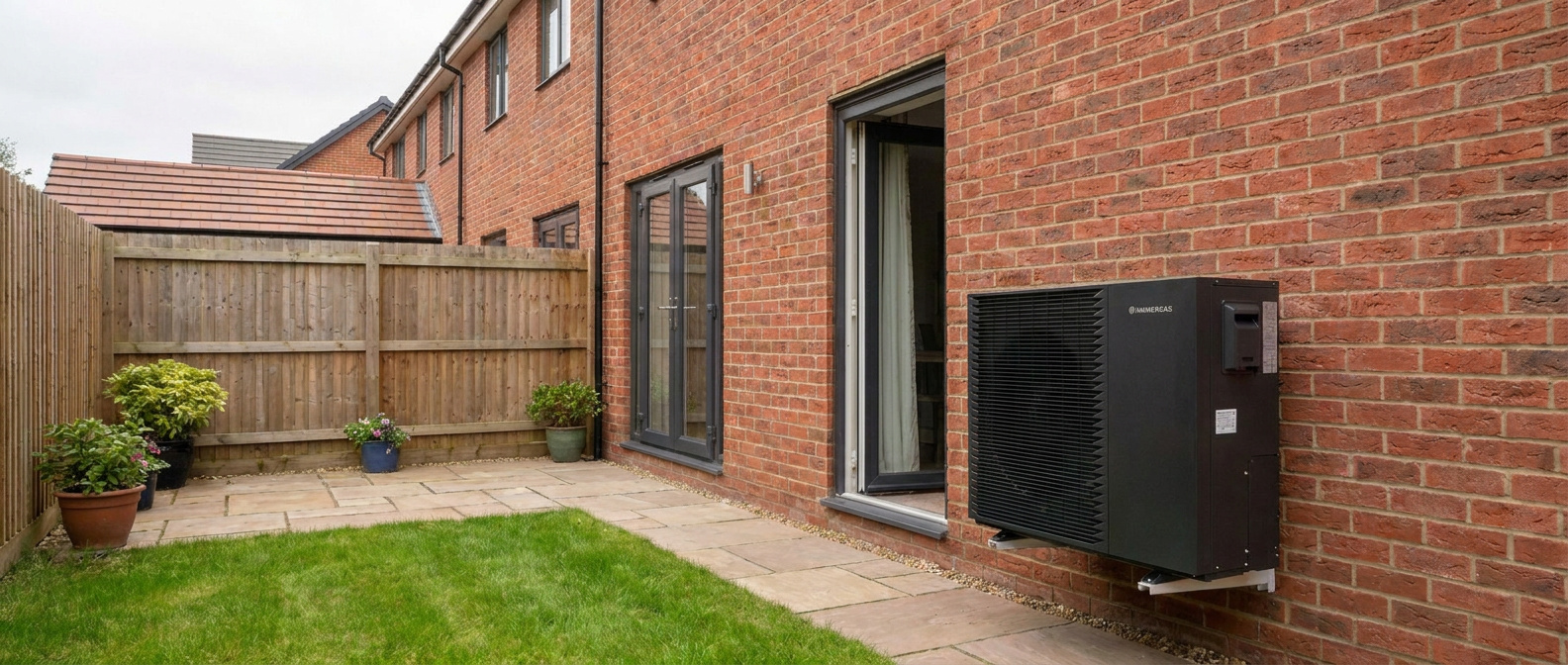
Alliant Energy installs air source heat pumps in Lancashire. A typical installation costs £8,000–£15,000 before grants — but our whole approach is to use the £7,500 Boiler Upgrade Scheme and any available uplift to reduce what you pay out of pocket. In many cases, qualifying homeowners pay little or nothing upfront. The Alpha Magis M Top is the heat pump we specify most often, although we may install another quality brand where the property or project requires it. We are based in Nelson, Lancashire and are MCS-registered and TrustMark registered.
Installing in Greater Manchester? See our Greater Manchester heat pump installers page for borough-by-borough costs, grant take-up and Warm Homes: Local Grant eligibility.
Key takeaways
- Air source heat pumps for Lancashire — MCS-registered installation with the £7,500 BUS grant deducted from your invoice.
- Alpha Magis M Top is our main unit — a monobloc R290 heat pump we specify, install and commission. Other quality brands are used where the project requires.
- £7,500 BUS grant available to all homeowners in England replacing a fossil fuel heating system — applied directly to your installer invoice.
- £9,000 grant for off-gas-grid Lancashire properties from 21 July 2026 to 31 March 2027 — e.g. rural Ribble Valley and Forest of Bowland homes on oil or LPG.
- Our USP: we do everything we can to install your heat pump with as little customer contribution as possible. The BUS grant is central to that.
- Running costs £700–£1,200/year on standard tariff; as low as £500–£900 on a heat pump optimised tariff.
- Quiet, efficient operation — from 35 dB(A), A+++ low-temp efficiency, and no F-Gas certificate required on R290 models.
- BUS scheme runs to 31 December 2029 — but budgets can be withdrawn early; quotes secured now lock in eligibility.
How much does an air source heat pump cost in Lancashire in 2026?
A typical air source heat pump installation in Lancashire costs £8,000–£15,000 fully installed before grants in 2026. The range reflects property size, existing infrastructure, and any associated work. The figure below is a realistic starting point — but Alliant Energy's focus is on using the BUS grant to reduce your contribution, not on quoting a headline price.
| Property type | Typical installed cost before grant | After £7,500 BUS grant |
|---|---|---|
| 2-bed terrace or flat | £7,000–£10,000 | £0–£2,500 |
| 3-bed semi-detached | £9,000–£13,000 | £1,500–£5,500 |
| 4-bed detached | £11,000–£15,000 | £3,500–£7,500 |
| Off-gas-grid (after £9,000 uplift) | £11,000–£15,000 | £2,000–£6,000 |
These figures include the heat pump unit, refrigerant pipework, primary circuit connections, controls and thermostat, scaffolding or access if needed, commissioning and MCS certification. We most often specify the Alpha Magis M Top, but we may use another quality brand where the project requires it. They do not automatically include a new hot water cylinder, radiator upgrades, or electrical consumer unit upgrades — these are assessed during the survey and quoted separately.
Our USP: we minimise your contribution
Alliant Energy is different to most installers. While the typical cost of an air source heat pump is £8,000–£15,000, our process is designed to use the Boiler Upgrade Scheme and any available local or national funding to reduce what you actually pay.
For many qualifying Lancashire homeowners, this means:
- The £7,500 BUS grant is deducted from your invoice before you pay anything — we handle the application.
- Off-gas-grid properties may qualify for the enhanced £9,000 grant from July 2026.
- We assess whether Warm Homes Plan or other funding can further reduce your contribution.
- We quote honestly: if extra work is needed, we tell you before installation starts.
Our aim is simple: get you a high-quality air source heat pump installation with the smallest possible upfront contribution. The Alpha Magis M Top is the unit we specify most often, but we may install another quality brand where the property or project requires it.
What does the £7,500 Boiler Upgrade Scheme grant cover — and who qualifies?
The Boiler Upgrade Scheme (BUS) is a UK Government grant for homeowners in England and Wales replacing a fossil fuel heating system (gas, oil, LPG or electric storage heaters) with an air source or ground source heat pump. The grant is £7,500 — paid directly to your MCS-registered installer and deducted from your invoice before you pay anything.
BUS eligibility checklist for Lancashire homeowners
- You own the property (homeowner or small business owner)
- Property is in England (Lancashire qualifies)
- You are replacing an existing fossil fuel or electric heating system
- Property has a valid Energy Performance Certificate (EPC)
- Any recommended loft or cavity wall insulation on your EPC must be completed first
- Property is not a new build
- You have not previously claimed BUS at this property
- Installer is MCS-registered (Alliant Energy qualifies)
Alliant Energy submits the BUS application on your behalf before installation begins — you do not need to engage with Ofgem directly. Typical approval takes 2–4 weeks from application. The grant is confirmed in writing before any work starts.
Off-gas-grid uplift from July 2026
For full eligibility, see our Boiler Upgrade Scheme 2026 guide and Warm Homes Plan heat pump guide.
What are the additional costs beyond the heat pump unit itself?
The headline installation price covers the heat pump unit and primary installation. We most often specify the Alpha Magis M Top, but other quality brands may be used where the project requires. For most Lancashire homes, the survey will also identify one or more of the following additional items. Understanding these upfront avoids surprises and lets us plan the funding needed.
| Additional item | Typical cost | When needed |
|---|---|---|
| Hot water cylinder | £500–£1,500 | Homes switching from a combi boiler have no existing cylinder. A correctly sized unvented indirect cylinder (180–250L) is required. A modern cylinder (post-2015) of the right capacity may be retained. |
| Radiator upgrades | £150–£400 per room | Heat pumps run at 35–50°C flow temperature vs a gas boiler's 60–80°C. Undersized radiators need replacing. Most Lancashire installs need upgrades in 1–3 rooms. |
| Pipework modifications | £200–£800 | Routing refrigerant pipework from the outdoor unit to the indoor unit. Length and access complexity determine cost. |
| Consumer unit / electrical upgrade | £300–£600 | If your existing consumer unit lacks a dedicated circuit for the heat pump's draw, an upgrade is required. Most homes built after 2000 are fine. |
| Insulation (pre-BUS requirement) | £300–£1,500 | BUS eligibility requires any EPC-recommended loft or cavity wall insulation first. Many Lancashire homes already have these. If needed, may qualify for Warm Homes Plan funding. |
| Buffer vessel | £200–£500 | Sometimes required for hydraulic separation in larger systems. Not always needed — determined by system design at survey. |
A realistic all-in budget for a 3-bed Lancashire semi with a combi boiler (requiring a new cylinder and 2 radiator upgrades) is approximately £12,000–£14,500 before the BUS grant, or £4,500–£7,000 after the £7,500 grant. Off-gas-grid properties may see this fall further with the £9,000 uplift.
How much does an air source heat pump cost to run in Lancashire?
Heat pump running costs depend on three variables: the electricity tariff you use, the efficiency (COP) of the installed system, and how much heat your home needs. Lancashire's climate is relevant: the region's average winter temperatures of 3–7°C mean heat pumps operate in the middle of their efficiency curve most of the time.
| Heating scenario | Annual electricity cost | Gas boiler equivalent | Annual saving vs gas |
|---|---|---|---|
| ASHP on standard tariff (25.2p/kWh), COP 2.8 | £900–£1,200 | £900–£1,400 | Roughly comparable |
| ASHP on heat pump tariff (~13p off-peak), COP 3.0 | £600–£900 | £900–£1,400 | £200–£600/year |
| ASHP + solar panels (free daytime), COP 3.2 | £400–£700 | £900–£1,400 | £400–£900/year |
| Oil boiler replacement (rural Lancashire) | £600–£900 (on heat pump tariff) | £1,600–£2,400 | £700–£1,500/year |
Running costs based on Ofgem Q3 2026 average electricity unit rate of 25.2p/kWh for the North West (Electricity North West distribution zone). Gas at 5.74p/kWh. Oil at ~75p/litre. Consumption estimates for a 3-bed semi in Lancashire with 12,000–15,000 kWh annual heat demand. COP figures based on a modern monobloc air source heat pump at A7/W35 operating condition.
The North West electricity rate context
Get a free heat pump survey and BUS grant assessment
Alliant Energy is an MCS-registered installer in Nelson, Lancashire. We handle your BUS application, heat loss survey, system design and heat pump installation.
How does heat pump cost compare to a gas boiler replacement in Lancashire?
A like-for-like comparison requires looking at both the upfront cost and the lifetime running costs, because a gas boiler is cheaper to install but more expensive to run as carbon costs are progressively priced into gas tariffs.
| Factor | Air Source Heat Pump | Gas Boiler Replacement |
|---|---|---|
| Install cost (3-bed semi) | £10,000 (£2,500 after BUS) | £2,000–£3,500 |
| Annual running cost (standard tariff) | £900–£1,200 | £900–£1,400 |
| Annual running cost (smart tariff) | £600–£900 | N/A |
| Government grant available | £7,500 BUS | None |
| Expected lifespan | 20–25 years | 10–15 years |
| Carbon trajectory (2026–2035) | Improving as grid decarbonises | Worsening as carbon costs rise |
| Pairs with solar panels | Yes — directly reduces running cost | No direct synergy |
The upfront cost difference between a heat pump and a boiler after the BUS grant (approximately £0–£4,500 for most Lancashire homeowners) is recovered through lower running costs over 3–7 years, depending on tariff choice and solar pairing. For rural Lancashire homeowners replacing oil boilers, the case is significantly stronger — the running cost saving of £700–£1,500/year on a heat pump vs oil means payback is often under 4 years after the £9,000 off-gas-grid grant.
Which heat pump does Alliant Energy install?
The Alpha Magis M Top is the air source heat pump we specify, source, install and commission most often. It is a monobloc R290 unit and the default choice for our Lancashire installations. That said, some properties or project briefs suit a different model — for example, where a specific output range, physical size constraint, or manufacturer preference applies — and in those cases we may install another quality brand from our approved range.
Why the Alpha Magis M Top is our main unit
- R290 natural refrigerant — extremely low global warming potential (GWP = 0.02), zero ozone depletion, and no F-Gas certification required because the unit is hermetically sealed.
- Range of outputs — available in 5kW, 8kW, 12kW and 16kW versions, plus 12kW and 16kW three-phase options. We size the unit to your property's heat loss.
- Up to 75°C flow temperature — central heating; 65°C for domestic hot water, without needing additional heat sources. This makes it suitable for radiator-based systems as well as underfloor heating.
- Ultra-quiet operation — just 35 dB(A), with a single fan and Silent Mode function.
- High efficiency — A+++ at low temperature (35°C flow) and A++ at medium temperature (55°C flow).
- MCS / HP Keymark certified — qualifies for the Boiler Upgrade Scheme grant.
- Built-in hydronic components — circulation pump, expansion vessel, flow meter, pressure sensor, Y filter, condensate drain and external probe are standard.
- Smart home ready — optional Gateway Wi-Fi V2 for app-based remote control, compatible with Alexa and Google Home.
A complete system, not just a box
What affects the final cost of heat pump installation in Lancashire?
Understanding the cost drivers lets you have a more useful conversation with any installer. Here are the seven variables that most affect the final quote:
- Property heat loss (kW demand) — the single biggest driver. A well-insulated modern 3-bed semi might need a 7kW unit; a poorly insulated Victorian stone terrace might need 12kW or more. Improving insulation before installation reduces the required unit size and long-term running costs.
- Combi boiler conversion — if you currently have a combi boiler, you have no hot water cylinder. Adding one costs £500–£1,500. A system boiler with an existing cylinder may be retained.
- Radiator sizing — undersized radiators are the most common cause of poor heat pump performance and the most common source of additional cost. Upgrades cost £150–£400 per room.
- Outdoor unit location and access — most Lancashire terraces and semis have limited outdoor space. Complex access, roof mounting, or long refrigerant pipe runs add cost.
- Electrical infrastructure — heat pumps draw continuous power. Older boards sometimes need an upgrade (£300–£600).
- System controls and smart thermostat — the Alpha NEXIS panel and E-BOX TOP are included when we specify the Alpha Magis M Top. Smart home integration is optional.
- Off-gas-grid fuel type — replacing oil or LPG makes the financial case stronger and qualifies for the enhanced £9,000 BUS grant from July 2026. Rural Lancashire properties on oil are among the best-value heat pump candidates in the UK.
Does a heat pump work in Lancashire's climate?
Yes — and the concern that heat pumps are unsuitable for the North of England is based on outdated technology. Modern air source heat pumps maintain strong performance at low outdoor temperatures and are rated for UK winter conditions. Lancashire's climate — characterised by mild, wet winters rather than sustained cold — is close to ideal heat pump operating conditions for much of the heating season.
The Pendle Valley, Ribble Valley, and Fylde Coast rarely experience sustained temperatures below -5°C. When they do, a quality heat pump continues to operate — it simply modulates output through its inverter compressor. On the coldest Lancashire days, the heat pump is still producing multiple units of heat per unit of electricity — significantly more efficient than direct electric heating, and equivalent to a modern condensing boiler at its peak.
The more relevant question for Lancashire is insulation quality. A well-insulated home allows the heat pump to run at lower flow temperatures (35–45°C) for long periods at high efficiency. If your EPC is D or below, addressing loft and cavity wall insulation before installation will noticeably reduce both the required heat pump size and the annual running cost.
For more on how renewable technology performs in Northern England, see our guide: do solar panels work in the North of England?
Can I combine a heat pump with solar panels in Lancashire?
Yes — and in 2026 this is the most financially compelling home energy configuration available in Lancashire. Solar panels generate free electricity during daylight hours, particularly during spring and autumn when your heating demand is still meaningful (overnight temperatures of 5–10°C) but daytime solar production is strong.
The economics work as follows: your solar panels generate electricity at zero marginal cost. Your heat pump consumes that electricity instead of drawing from the grid at 25.2p/kWh. A well-timed heat pump pre-heating run during peak solar hours (10:00–15:00) can offset a significant portion of the day's heating load. Adding a battery storage system extends this further — the battery stores surplus solar generation and dispatches it to the heat pump in the evening or overnight.
Alliant Energy designs combined solar + heat pump systems as a single integrated project. We specify the solar array size, battery capacity, heat pump output, and control system together — rather than adding components piecemeal. See our Warm Homes Plan solar, battery and heat pump guide for the full cost and savings breakdown.
Get a free heat pump quote and BUS grant check
Answer a few questions below and we'll prepare a tailored quote, check your BUS grant eligibility, and arrange a home assessment if the numbers look right. No obligation and no hard sell.
What type of property do you live in?
Frequently asked questions — air source heat pump cost Lancashire
Which heat pump does Alliant Energy install?
The Alpha Magis M Top monobloc air source heat pump is our main unit. It uses R290 natural refrigerant, runs at just 35 dB(A), achieves A+++ efficiency at low temperature, and is MCS / HP Keymark certified — so it qualifies for the £7,500 Boiler Upgrade Scheme grant. In some cases we may install another quality brand where the property or project requires it.
How much does an air source heat pump cost in Lancashire in 2026?
A fully installed air source heat pump in Lancashire typically costs £8,000–£15,000 before grants. After the £7,500 Boiler Upgrade Scheme grant, most homeowners pay £500–£7,500. A 3-bed semi typically costs around £10,000 installed, falling to £2,500 after the BUS grant. Off-gas-grid properties may qualify for £9,000 from July 2026.
What is Alliant Energy's USP on heat pump pricing?
We do everything we can to install your air source heat pump with as little customer contribution as possible. The £7,500 BUS grant is deducted from your invoice, and we look for any additional funding (such as the off-gas-grid uplift or Warm Homes Plan support) to reduce what you pay out of pocket.
What is the Boiler Upgrade Scheme and how do I apply?
The BUS is a £7,500 government grant for homeowners in England replacing fossil fuel heating with a heat pump. It is paid directly to your MCS-registered installer (Alliant Energy) and deducted from your invoice — you do not handle the money. Alliant submits the BUS application on your behalf before installation begins. Approval typically takes 2–4 weeks. The scheme runs to 31 December 2029.
How much does an air source heat pump cost to run in Lancashire?
A well-designed heat pump in Lancashire typically costs £700–£1,200/year on a standard tariff (Ofgem Q3 2026 rate of 25.2p/kWh). On a heat pump optimised tariff, running costs fall to £500–£900/year. Pairing with solar panels further reduces costs to £400–£700/year by generating free daytime electricity for the heat pump.
Will I need new radiators for a heat pump in Lancashire?
Not necessarily. Heat pumps run at lower flow temperatures (35–50°C) than gas boilers. Alliant's heat loss survey calculates whether your existing radiators can deliver sufficient heat at these temperatures. Most Lancashire installs need upgrades in 1–3 rooms at £150–£400 per room. Victorian stone-built properties tend to need more upgrading; modern semis tend to need less.
Do heat pumps work in Lancashire's climate?
Yes. Modern air source heat pumps operate efficiently at low outdoor temperatures and are rated for UK winter conditions. Lancashire's mild, wet winters are close to ideal for heat pump operation. A quality heat pump continues to run on the coldest Lancashire days, delivering heat far more efficiently than direct electric heating.
Can I get a bigger grant if my house is off the gas grid?
Yes. From 21 July 2026 to 31 March 2027, off-gas-grid properties (oil, LPG, or solid fuel heating) can claim £9,000 under the BUS — £1,500 more than the standard grant. This applies to rural Lancashire properties in the Ribble Valley, Forest of Bowland, Pendle rural fringe, and similar areas. Mention your fuel type when you request your quote.
How long does heat pump installation take?
A typical residential heat pump installation in Lancashire takes 2–3 days on site. The BUS grant application must be submitted and approved before installation — allow 2–4 weeks for this. Alliant handles the application; most customers go from initial enquiry to switch-on in 6–10 weeks.
Does Alliant Energy use certified heat pump installers in Lancashire?
Yes. Every Alliant Energy heat pump installation is carried out by MCS-registered installers, and we are TrustMark registered. MCS registration is the mandatory requirement for all BUS grant applications. Alliant is based in Nelson, Lancashire (BB9), serving the whole of Lancashire and Greater Manchester.
Further reading
- Heat pump installers in Greater Manchester — costs, grants & local data
- Solar panel installation — pair with your heat pump
- Solar battery storage — cut running costs further
- Warm Homes Plan — solar, battery & heat pump
- Warm Homes Plan heat pump guide
- Boiler Upgrade Scheme 2026 — full eligibility
- Do solar panels work in the North of England?
- Warm Homes Local Grant Lancashire

