Here's exactly what to expect at each stage.
Step 1 — Getting a quote (1 working day)
You submit an enquiry — online form, phone, or email — telling us about your property, current electricity use, and what you're interested in (panels only, panels + battery, etc.). We come back within one working day with a detailed, fixed-price proposal including:
- System specification (panels, inverter, battery, monitoring)
- Estimated annual generation
- Estimated annual bill saving and SEG earnings
- Payback period
- All warranties
This is a proposal, not a binding contract. You're under no obligation to proceed.
Step 2 — Survey (free)
For most installations, we'll arrange a free site survey before confirming the final quote. One of our engineers visits to:
- Confirm roof orientation, pitch and useable area
- Check for shading from chimneys, trees or neighbouring buildings
- Identify cable routing from roof to consumer unit
- Confirm structural suitability (most UK roofs are fine)
- Discuss battery placement (garage, utility room, etc.)
The survey typically takes 45–60 minutes. For straightforward installs, some customers prefer to proceed from photos rather than a visit — we can usually accommodate this.
Step 3 — DNO application (10–25 working days)
Before installing, we submit a G98 or G99 application to your Distribution Network Operator (DNO) — the company that manages the electricity network in your area. This is a regulatory requirement for any solar installation.
Most domestic systems below 3.68 kWp only require a G98 notification (no approval needed — just notification). Larger systems need a G99 application with DNO approval, which takes 10–25 working days. We handle this entirely on your behalf and keep you updated.
Timeline
Step 4 — Installation (1–2 days)
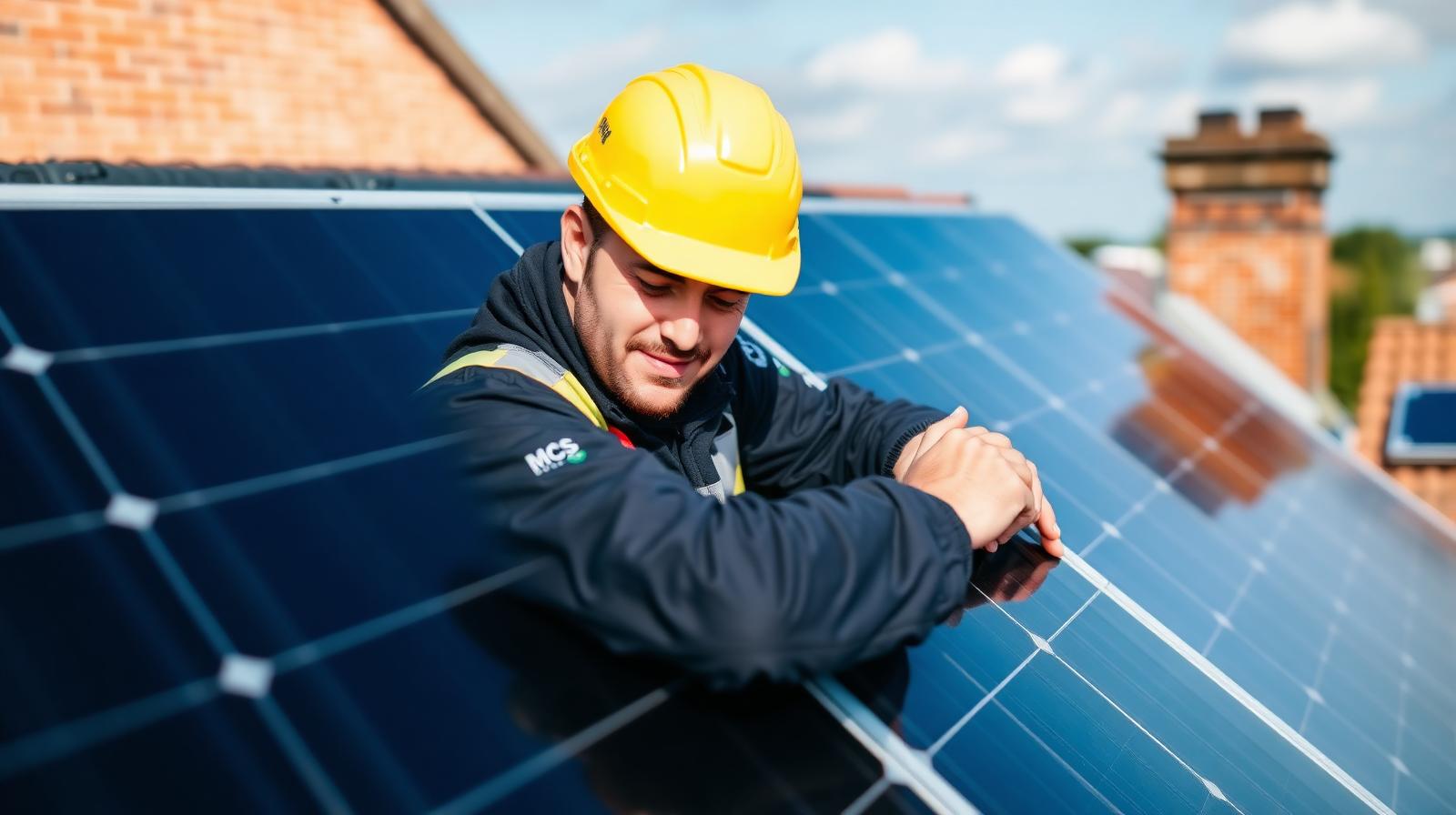
Installation day is straightforward. Our team arrives, erects scaffolding, mounts the rail system on your roof, fits the panels, runs cable down to the inverter and battery location, and commissions the system.
What happens on the day:
- Morning: scaffolding erected, rails and panels fitted to roof
- Afternoon: cable routing, inverter and battery installation, system commissioning
- End of day: system tested, app set up, brief walkthrough with you on how to use it
For a standard 8-panel + battery system, installation takes one full day. Larger or more complex systems may take two days. We work around your schedule and leave the site clean.
Step 5 — MCS certificate (within days)
Within a few days of commissioning, you receive your MCS installation certificate. This is one of the most important documents you'll receive — keep it safely. The MCS certificate is required for:
- Registering for Smart Export Guarantee (SEG) payments
- Accessing government grant schemes (Warm Homes Plan etc.)
- Validating manufacturer warranties
- Providing proof of compliant installation if you sell the property
Step 6 — Smart Export Guarantee registration
Once you have your MCS certificate, you can apply to your energy supplier for SEG payments. You don't have to use your existing supplier — it's worth comparing rates. We guide you through the registration process.
Most suppliers process SEG applications within 10–20 working days. Once registered, you'll receive quarterly payments for every unit you export — typically 4–15p/kWh depending on your supplier.
Start the process — get a quote
Quote in one working day. Installation in 4–8 weeks.
After the installation — what to expect from your system
In the first few months, you'll likely be checking the monitoring app frequently. That's normal. You'll see daily generation figures, self-consumption rates, and export volumes. Most systems perform very close to projected figures.
The Levelise Hub app (included with every Alliant system) shows real-time data and allows you to adjust your charging and export preferences. We're available if anything looks unusual — and our warranty means any component issues are covered.
Frequently asked questions
Will I need to be home during installation?
Yes — someone needs to be home on installation day to give access and to receive the handover briefing at the end. You don't need to supervise the installation; our team will work independently.
Is scaffolding included?
Yes — scaffolding to one elevation is included in all our packages. If your property requires scaffolding to multiple elevations, we'll discuss any additional cost when we quote.
Will the installation cause any damage to my roof?
No structural damage. Our mounting system uses rail brackets fixed through the roof covering to the rafters below. The penetrations are sealed with EPDM flashing to prevent water ingress.
What if something goes wrong after installation?
Contact us — we're accountable. As HIES members, there's a formal dispute resolution process if needed. The system is covered by manufacturer warranties (10 years on the inverter, 25–30 years on panels) and our own workmanship guarantee.
