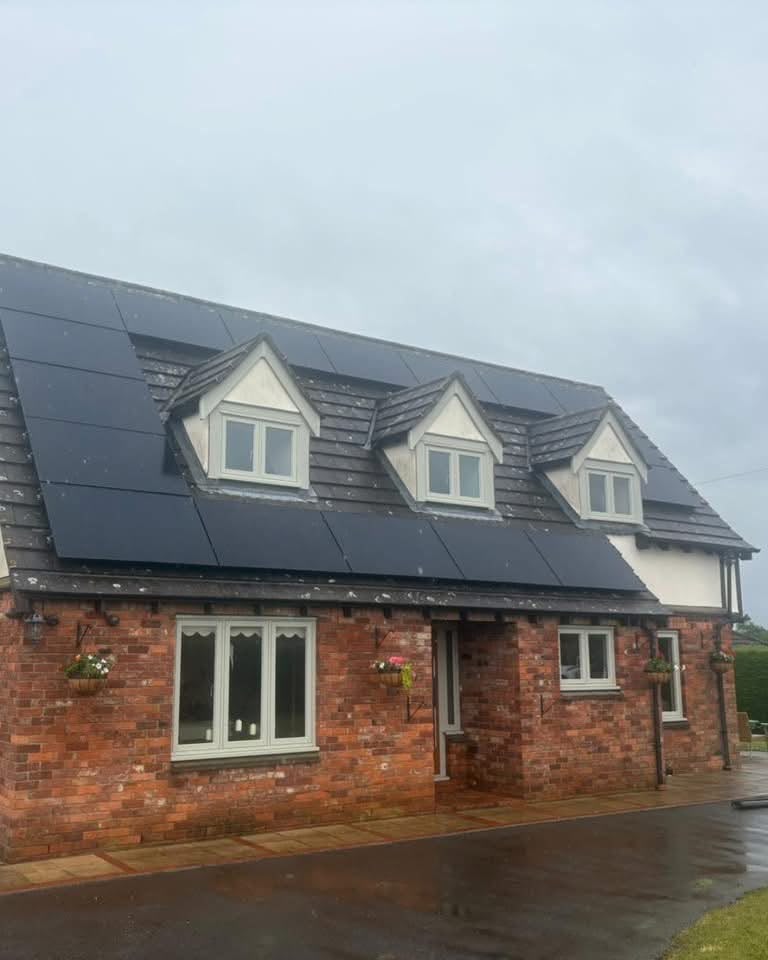
It's all in the details. Another high-performance install completed by Alliant Energy Ltd, this one in Lytham St Anne's. 25 × 475W all-black solar panels neatly integrated across the front elevation and dormers, paired with a 15kW Sigenergy 3-phase hybrid inverter and 18kWh of Sigenergy battery storage (2 × 9kWh). A powerful setup built to maximise self-consumption, cut energy bills, and future-proof the home with clean, renewable power. Clean install. Smart design. Strong output. Thinking about solar or battery storage? Get in touch for clear, honest advice — no pressure.
The challenge
Like most domestic / residential operations, Lytham St Anne's Residential faced a structural exposure to wholesale electricity prices — a cost line that doubled for many UK businesses between 2021 and 2023 and shows no sign of returning to pre-crisis levels. With significant daytime load and suitable roof space, on-site generation was the obvious lever, but the project needed to stand on its own commercial merits: predictable payback, manufacturer-backed warranties, and zero operational disruption during install.
The solution Alliant Energy designed
Following a structural roof survey and DNO capacity check, Alliant Energy specified a 11.87kWp array using 25 × 475W high-efficiency mono-PERC panels, paired with a Sigenergy 15kW 3-phase hybrid inverter and 18kWh (2 × 9kWh Sigenergy) of lithium iron phosphate (LFP) battery storage. The Sigenergy 15kW 3-phase platform was chosen for its export-management capability and remote firmware updates, allowing the array to be tuned over its life without site visits. Battery storage was sized to absorb mid-day generation peaks and discharge across the early evening, lifting on-site solar self-consumption from a typical 35–45% to over 70%.
Install & commissioning
The full installation completed in 3 days, scheduled around the customer's operating hours to avoid downtime. Work was carried out by Alliant Energy's directly employed MCS-registered engineers — no subcontracted labour. The system was commissioned to G99 requirements, registered with the Microgeneration Certification Scheme, and handed over with monitoring access, electrical certification, and structural sign-off documents on the day of completion.
Financial outcome
In its first full year of operation the system is on track to save Lytham St Anne's Residential approximately £2,650 on electricity costs, with a payback term of 5.9 Years and a projected total ROI of 525%. Over the 25-year warranted life of the panels, the cumulative saving is forecast at £66,250 — a figure that improves materially if grid prices continue their long-term upward trend, and that benefits from the UK's 100% full-expensing capital allowance for qualifying solar assets.
Environmental impact
The installation displaces roughly 2.8 Tonnes of CO₂ emissions every year compared with grid-sourced electricity. Over the system's 25-year design life that is the equivalent of removing more than Lytham St Anne's Residential's entire annual Scope 2 footprint several times over — a material data point for ESG, B-Corp and net-zero reporting frameworks.
Why it matters for the domestic / residential sector
Domestic / Residential businesses typically run daytime electrical loads — refrigeration, machinery, IT, lighting, compressors — that overlap closely with solar generation. That overlap is what drives strong economics: every unit generated and consumed on-site replaces a unit that would otherwise be bought from the grid at full commercial rates. The Lytham St Anne's Residential project demonstrates how the model scales for this kind of operation.