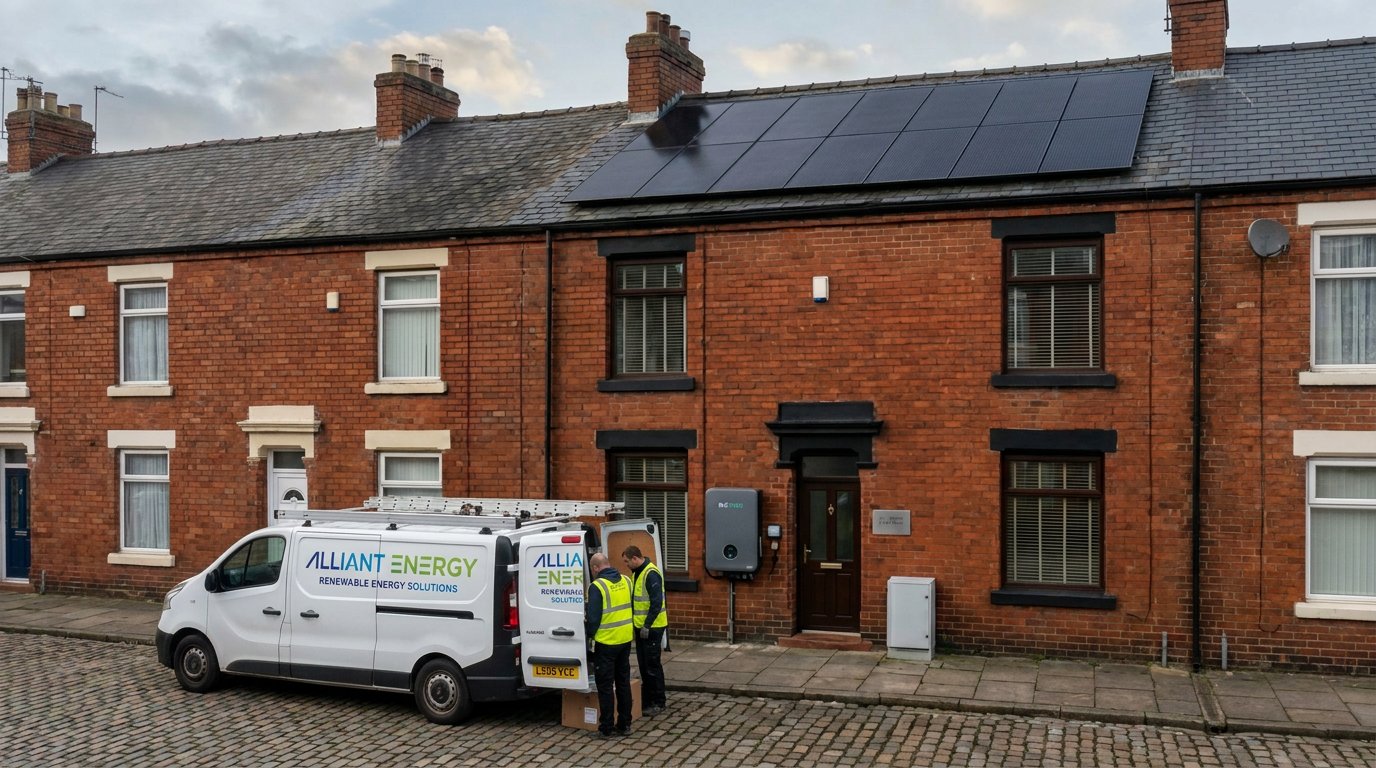
A 3-bedroom Victorian mid-terrace in Burnley (BB11) was facing electricity bills climbing toward £2,100 per year. The Harrisons were sceptical that North West weather could justify solar and wanted to cut their gas dependency. Alliant Energy designed a high-efficiency package for the Lancashire climate: 10 high-performance all-black panels optimised for low-light conditions, a 10kWh smart battery sized to capture a full day's generation for evening use, and integration with a dynamic smart tariff so the battery can top up from the grid at just 7p/kWh overnight when the next day is forecast cloudy. In the first 12 months the home cut its annual bill by 82%, ran 94% on its own stored energy through the summer, and earned £180 in export payments. "Even on a rainy Tuesday, our battery is powering the kettle and the TV. Our last monthly bill was under £20. It's been life-changing." — The Harrison Family, Burnley.
The challenge
Like most domestic / residential operations, The Harrison Family — Burnley Terrace faced a structural exposure to wholesale electricity prices — a cost line that doubled for many UK businesses between 2021 and 2023 and shows no sign of returning to pre-crisis levels. With significant daytime load and suitable roof space, on-site generation was the obvious lever, but the project needed to stand on its own commercial merits: predictable payback, manufacturer-backed warranties, and zero operational disruption during install.
The solution Alliant Energy designed
Following a structural roof survey and DNO capacity check, Alliant Energy specified a 4.2kWp array using 10 high-efficiency mono-PERC panels, paired with a Hybrid 5kW hybrid inverter and 10kWh of lithium iron phosphate (LFP) battery storage. The Hybrid 5kW platform was chosen for its export-management capability and remote firmware updates, allowing the array to be tuned over its life without site visits. Battery storage was sized to absorb mid-day generation peaks and discharge across the early evening, lifting on-site solar self-consumption from a typical 35–45% to over 70%.
Install & commissioning
The full installation completed in 2 days, scheduled around the customer's operating hours to avoid downtime. Work was carried out by Alliant Energy's directly employed MCS-registered engineers — no subcontracted labour. The system was commissioned to G99 requirements, registered with the Microgeneration Certification Scheme, and handed over with monitoring access, electrical certification, and structural sign-off documents on the day of completion.
Financial outcome
In its first full year of operation the system is on track to save The Harrison Family — Burnley Terrace approximately £1,830 on electricity costs, with a payback term of 6.3 Years and a projected total ROI of 510%. Over the 25-year warranted life of the panels, the cumulative saving is forecast at £45,750 — a figure that improves materially if grid prices continue their long-term upward trend, and that benefits from the UK's 100% full-expensing capital allowance for qualifying solar assets.
Environmental impact
The installation displaces roughly 920kg of CO₂ emissions every year compared with grid-sourced electricity. Over the system's 25-year design life that is the equivalent of removing more than The Harrison Family — Burnley Terrace's entire annual Scope 2 footprint several times over — a material data point for ESG, B-Corp and net-zero reporting frameworks.
Why it matters for the domestic / residential sector
Domestic / Residential businesses typically run daytime electrical loads — refrigeration, machinery, IT, lighting, compressors — that overlap closely with solar generation. That overlap is what drives strong economics: every unit generated and consumed on-site replaces a unit that would otherwise be bought from the grid at full commercial rates. The The Harrison Family — Burnley Terrace project demonstrates how the model scales for this kind of operation.