How big is the solar system installed at Boeing Flight Services?
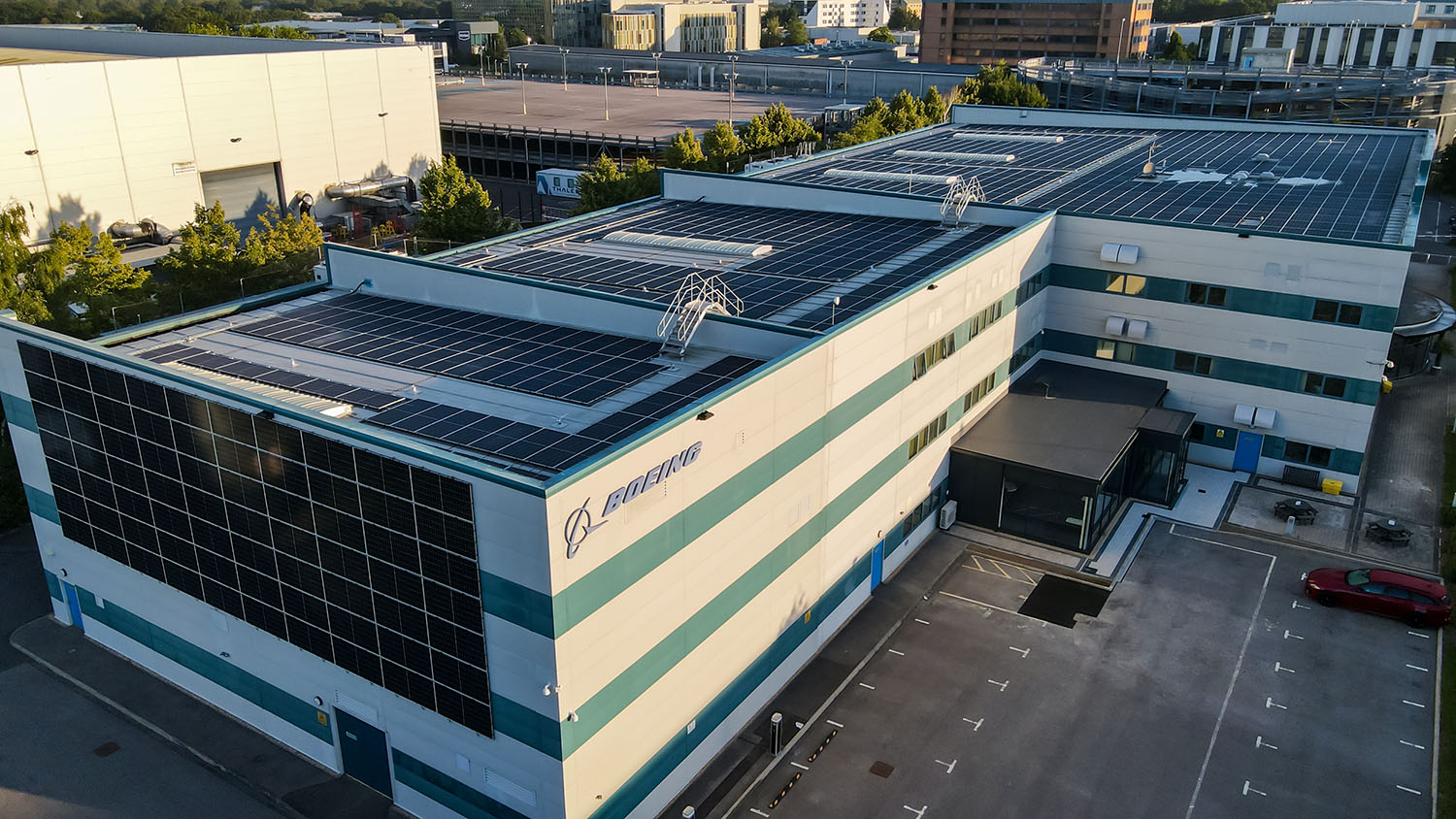
Alliant Energy installed a 453.56kWp solar PV system using 1031 panels paired with a SolarEdge inverter. The installation took 1 month from arrival on site to commissioning.
Aerospace
453.56kWp system saving £100,527 a year for Boeing Flight Services.
Our installation for the leading aerospace organisation, Boeing, comprises roof-mounted and industry-leading wall-mounted solar PV, totalling over 450kWp of energy generation, maximising space available. .e-loop-item-13340 .elementor-element.elementor-element-166d83a:not(.elementor-motion-effects-element-type-background),.e-loop-item-13340 .elementor-element.elementor-element-166d83a>.elementor-motion-effects-container>.elementor-motion-effects-layer{background-image:url("https://alliantenergy.co.uk/wp-content/uploads/2026/02/Bowland-Pennine-Mountain-Rescue-Solar-11.jpg")}.e-loop-item-13340 .elementor-element.elementor-element-166d83a:hover{background-image:url("https://alliantenergy.co.uk/wp-content/uploads/2026/02/Bowland-Pennine-Mountain-Rescue-Solar-11.jpg")}
Like most aerospace operations, Boeing Flight Services faced a structural exposure to wholesale electricity prices — a cost line that doubled for many UK businesses between 2021 and 2023 and shows no sign of returning to pre-crisis levels. With significant daytime load and suitable roof space, on-site generation was the obvious lever, but the project needed to stand on its own commercial merits: predictable payback, manufacturer-backed warranties, and zero operational disruption during install.
Following a structural roof survey and DNO capacity check, Alliant Energy specified a 453.56kWp array using 1031 high-efficiency mono-PERC panels, paired with a SolarEdge hybrid inverter. The SolarEdge platform was chosen for its export-management capability and remote firmware updates, allowing the array to be tuned over its life without site visits. Surplus generation is exported to the grid under a Smart Export Guarantee tariff, providing a secondary revenue stream alongside the primary saving on imported electricity.
The full installation completed in 1 month, scheduled around the customer's operating hours to avoid downtime. Work was carried out by Alliant Energy's directly employed MCS-registered engineers — no subcontracted labour. The system was commissioned to G99 requirements, registered with the Microgeneration Certification Scheme, and handed over with monitoring access, electrical certification, and structural sign-off documents on the day of completion.
In its first full year of operation the system is on track to save Boeing Flight Services approximately £100,527 on electricity costs, with a payback term of 5.4 Years and a projected total ROI of 463%. Over the 25-year warranted life of the panels, the cumulative saving is forecast at £2.51M — a figure that improves materially if grid prices continue their long-term upward trend, and that benefits from the UK's 100% full-expensing capital allowance for qualifying solar assets.
The installation displaces roughly 94.7 Tonnes of CO₂ emissions every year compared with grid-sourced electricity. Over the system's 25-year design life that is the equivalent of removing more than Boeing Flight Services's entire annual Scope 2 footprint several times over — a material data point for ESG, B-Corp and net-zero reporting frameworks.
Aerospace businesses typically run daytime electrical loads — refrigeration, machinery, IT, lighting, compressors — that overlap closely with solar generation. That overlap is what drives strong economics: every unit generated and consumed on-site replaces a unit that would otherwise be bought from the grid at full commercial rates. The Boeing Flight Services project demonstrates how the model scales for this kind of operation.
Alliant Energy installed a 453.56kWp solar PV system using 1031 panels paired with a SolarEdge inverter. The installation took 1 month from arrival on site to commissioning.
Boeing Flight Services saves approximately £100,527 per year on electricity, with projected lifetime savings of £2.51M over the system's 25-year guaranteed performance period. The payback term is 5.4 Years, delivering a total ROI of 463%.
This project was paid for directly by the customer. Under the UK's full-expensing capital allowance, the entire cost can be deducted from corporation tax in year one — improving the effective payback meaningfully for profitable companies.
The system avoids around 94.7 Tonnes of CO₂ emissions every year compared with grid-sourced electricity. Over a 25-year design life that's a material contribution toward Scope 2 reduction and any ESG or net-zero reporting commitments the business holds.
Probably — the same hardware platform (panels, hybrid inverter, optional battery) scales from roughly 10kW up to 1MW+. The deciding factors are roof area, daytime electricity use, current unit rate, and grid-connection capacity. Alliant Energy carries out a free desktop feasibility study and follow-up site survey before quoting.
Three ways to get started
Get a tailored quote in one working day. No obligation. No hard sell. Speak to a renewable energy engineer — not a salesperson — at a time that suits you.
Accreditations
MCS certification isn't a box-ticking exercise — it qualifies your system for Smart Export Guarantee payments and government grants. Our installers are also NICEIC-approved and TrustMark-registered, and every install is fully insured.
