
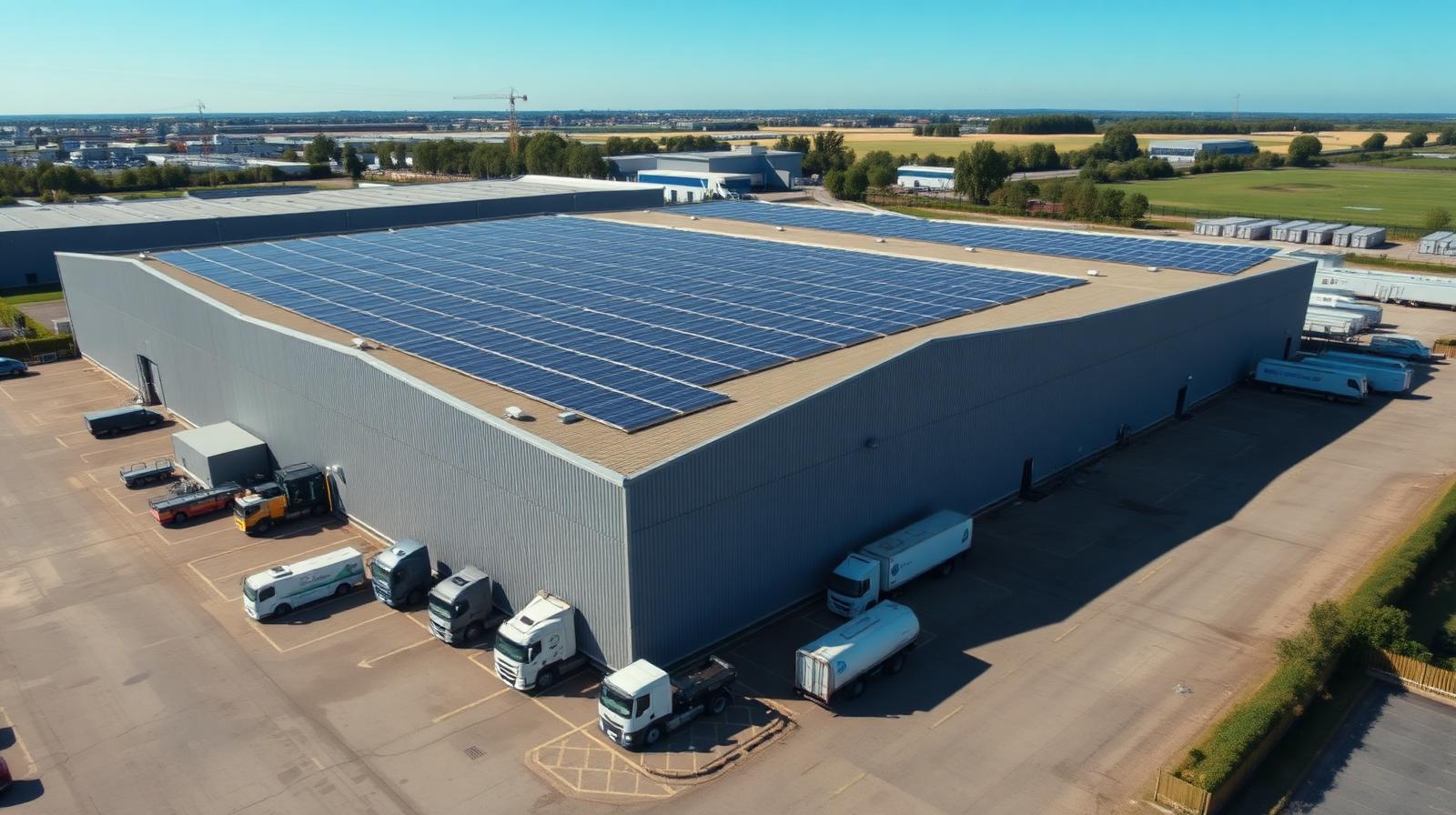
For businesses with significant car parking, a solar carport is one of the highest-value solar installations available.
What is a solar carport?
A structural steel canopy frame spans a car park, with solar panels mounted on the canopy roof. Underneath, EV charge points integrate into the uprights or stand ground-mounted alongside. Generation feeds into the building or directly powers the EV chargers below.
Unlike rooftop solar, carports don't depend on the building's roof condition, orientation or structural capacity. They can be installed on almost any flat car park surface, and the structure adds permanent weather protection value independent of solar output.
Who solar carports suit
- Car dealerships: forecourt and customer parking with EV charging is a sales and service differentiator
- Supermarkets and retail parks: customer EV charging from solar — a strong service and sustainability proposition
- Logistics and fleet operators: fleet EV charging from on-site solar
- Hotels and leisure facilities: guest EV charging as an amenity
- Office and business parks: staff EV charging, with generation feeding the building
- Sports clubs and arenas: car parks in use on event days, vacant other times — good for generation
Dealership example
What solar carports cost
Significantly more expensive per kWp than rooftop solar — the structural frame adds substantial cost.
| System size | Structure + panels | EV charging (added cost) |
|---|---|---|
| 25 kWp (10–12 spaces) | £80,000–£120,000 | £5,000–£15,000 for 4–6 chargers |
| 50 kWp (20–25 spaces) | £150,000–£220,000 | £10,000–£25,000 for 8–12 chargers |
| 100 kWp (40–50 spaces) | £280,000–£400,000 | £20,000–£50,000 for 16–24 chargers |
Payback periods are typically 6–10 years rather than 3–5 for rooftop. However, Full Expensing applies, EV charging income can accelerate payback, and the structure adds permanent value.
Workplace Charging Scheme
Site survey, planning view, full feasibility
Free commercial assessment for solar carports and integrated EV charging.
Planning considerations for solar carports
Solar carports are generally treated as new structures rather than modifications, so usually require planning permission rather than permitted development. However:
- Car park canopies are a familiar and uncontroversial application in most LPAs
- EPC and sustainability benefits are increasingly recognised as material planning benefits
- Solar carports in commercial settings are routinely approved across England, Wales and Scotland
- Listed buildings and conservation areas require additional consideration
Grid connection for solar carports
Carports connect via a G99 application (systems above 16A per phase) and feed the site's supply. If the site already has rooftop solar, the combined generation must be within DNO permitted export limits. We model this in advance and confirm capacity as part of feasibility.
The combined renewable energy car park
The most ambitious installations combine rooftop solar, solar carport, battery storage and EV charging into one integrated system. Generation from roof and carport feeds a common inverter and battery; EVs charge from stored solar or cheap overnight grid power. For a business spending £150,000+/year on electricity with a large car park and electrifying fleet, this approach can reduce total energy and fuel costs by 60–80% with a combined payback of 4–7 years.
Frequently asked questions
Can we install EV chargers in a solar carport without solar panels?
Yes — a carport with chargers and no solar is viable. Adding solar is usually recommended if capital allows: the incremental cost on an already-built carport is low, and generation pays back the marginal cost quickly.
Can we charge for EV use and generate revenue?
Yes. Many businesses operate chargers on a cost-recovery or profit basis. Combined with solar at low cost plus a commercial charge rate (25–45p/kWh), this can generate meaningful ancillary revenue.
How long does a solar carport structure last?
Typically designed to a 25–30 year lifespan, consistent with panel warranty. Steel structures are hot-dip galvanised for corrosion resistance. We confirm the structural warranty for each project.
Do solar carports count for BREEAM or sustainability ratings?
Yes — on-site renewable generation is a scoring criterion in BREEAM, LEED and other frameworks. Carports contribute to energy credits and may add transport/mobility credits when EV charging is included.
