

Key takeaways
- Real 2026 quotes shared on r/ukheatpumps for comparable 3-bed semis ranged from £750 to over £20,000 after the grant — a spread that itself signals inconsistent pricing, not proportional risk or complexity.
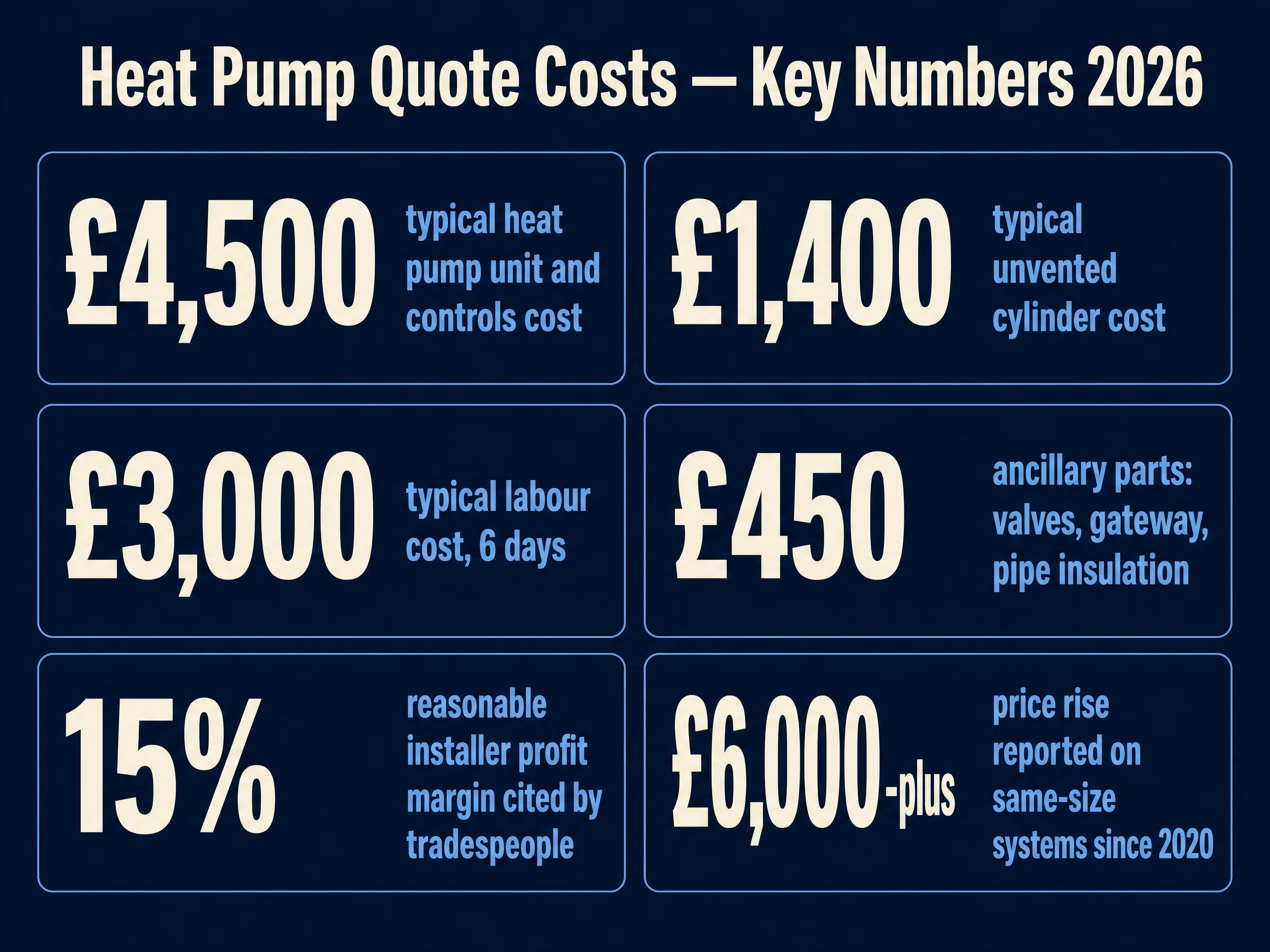
- One fully itemized breakdown totalled roughly £10,850 gross (heat pump and controls ≈£4,500, cylinder ≈£1,400, 7 radiators ≈£500, ancillaries ≈£450, pipework and insulation ≈£1,000, labour ≈£3,000) — about £5,000 net of a £7,500 or £9,000 grant deduction, in the poster's own words "≈15% profit territory."
- Ancillary parts genuinely cost money — anti-freeze valves at roughly £120 each, a heating gateway at around £300, plus pipe insulation and anti-vibration feet — but they don't come close to explaining five-figure gaps between similar jobs.
- Multiple homeowners reported the same size system costing thousands more after the grant than before it existed — one comparison cited a 10kW/250L system quoted at £8,000–£9,000 before any grant, and £7,000–£8,000 after a grant worth up to £9,000, which critics call "grant absorption".
- A dedicated "is a £12k quote normal?" thread found most posters with comparable 3-bed semis paid £3,000–£9,500 after the grant — £12,000-plus was flagged as high unless the job involved a full re-pipe, extensive radiator changes, or unusually poor access.
- The reliable fix: ask for an itemized breakdown — unit, cylinder, radiators, ancillaries, labour — rather than accepting a single lump-sum figure. A fair installer can show you the number behind the number.
How much should a heat pump cost after the Boiler Upgrade Scheme grant?
Based on dozens of real, dated quotes shared by homeowners on r/ukheatpumps through 2026, a straightforward air source heat pump installation for a 3-bed semi — new unvented cylinder, a handful of radiator changes, standard access — typically nets out at £2,500 to £9,500 after the £7,500 BUS grant (or £9,000 for oil/LPG switch-overs). Simpler jobs with existing infrastructure in place have gone as low as £750–£1,000; larger homes, full re-pipes, or difficult access can reasonably push a fair quote toward £10,000–£12,000. Anything materially outside that band, without an obvious reason why, is worth questioning.
What should be itemized in a heat pump quote?
A transparent quote breaks the job into the same handful of cost centres every time. Based on a detailed real-world breakdown shared on r/ukheatpumps for a completed installation, here's roughly where the money goes:
| Cost item | Typical range | Notes |
|---|---|---|
| Heat pump unit + controls | £3,500 – £4,500 | Varies by brand and kW size — retail-only unit prices are often £3,000–£4,000 before installation |
| Unvented hot water cylinder | £1,000 – £1,400 | Size depends on household hot-water demand, typically 180–300 litres |
| Radiator changes | £70 – £150 per radiator | Larger radiators or low-flow-temp units cost more; a full re-pipe of 7–13 radiators can add £2,000–£4,000 alone |
| Ancillary parts | £400 – £500 | Anti-freeze valves (~£120 each x2), heating gateway (~£300), pipe insulation, anti-vibration feet, buffer/low-loss header |
| Labour | £2,500 – £3,500 | Typically 5–6 days for plumber plus mate, plus roughly a day of electrician time for the isolator and wiring |
| MCS paperwork & commissioning | ≈£1,000 | Heat-loss survey, MCS design sign-off, grant paperwork and commissioning — cited by installers as a genuine, if often invisible, cost centre |
Source: itemized breakdown and ancillary-parts pricing shared by installers and homeowners on r/ukheatpumps, 2026. Individual jobs vary by property size, existing pipework condition and brand chosen.
Why do heat pump quotes vary so much for similar homes?
Some of the spread is genuinely explainable: heat-loss survey results, existing pipe diameter (microbore vs 15/22mm), how many radiators need replacing, cylinder location, and whether the property already has suitable electrics all move the price. But homeowners posting near-identical specs — same brand, same kW, same radiator count, same property type — have reported quotes differing by £5,000–£15,000 for what looks, on paper, like the same job. That gap is too wide to be explained by legitimate variation alone.
Installers on the same threads pointed to real cost pressures too: rising installer overheads, MCS membership and insurance costs, and — genuinely — demand outstripping the supply of qualified installers in some regions, which lets weaker competition get away with higher prices.
Are installers "grant absorbing" — pricing to soak up the BUS grant?
It's a widely-voiced suspicion, and there's real evidence behind at least some of it. One homeowner compared quotes for an identical 10kW/250L system taken a few years apart: roughly £8,000–£9,000 before any grant existed, and £7,000–£8,000 after a grant worth up to £9,000 became available — meaning the "discount" the grant was supposed to represent had largely evaporated into a higher headline price. That's not universal — plenty of installers quote consistently and pass the grant through in full — but it's common enough that it's worth checking for specifically, not assuming away. A separate "is a £12k quote normal?" thread found most comparable homeowners paying far less, reinforcing the same pattern.
"It's become normalised but it isn't right. It's typical grant scheme inflation. Before the BUS grant, we were quoted around £8-9k for our 10kw system with 250l tank. We've just had another round of quotes and guess what, £7-8k after the BUS grant. £6-7k inflation in 4-5 years, and the price of heat pumps have come down."— comment on r/ukheatpumps, "Cost after grant"
From our own installer
"The grant is meant to come off the top of a fair price, not be the reason the price went up in the first place. If a customer wants to see our unit cost, cylinder cost and labour laid out separately, we'll show them — there's nothing in our number we can't explain."
— Adam, Certified Installer at Alliant Energy
Sense-check your quote: 6 questions to ask before you sign
- Ask for an itemized breakdown, not just a total. Unit, cylinder, radiators, ancillaries and labour should each have their own line — an installer with nothing to hide can show this in minutes.
- Ask what the same job would have cost without a grant available. If the answer is vague or the number barely moves, that's a signal the grant may already be priced in.
- Get a second quote from a differently-structured installer. A direct MCS-registered local installer, a larger platform, and a specialist network price differently — comparing at least two exposes outliers fast.
- Check whether radiator changes are "required" or genuinely necessary. Ask to see the heat-loss survey's room-by-room numbers, not just a headline recommendation.
- Ask exactly what's included in "labour." Number of days, number of engineers, and whether MCS paperwork and commissioning are itemized separately or buried in a round number.
- Be wary of quotes built from a Rightmove listing or EPC alone. One homeowner was quoted a high price based on photos, then quoted roughly a third of that once an installer actually visited and surveyed the property in person.
Get a transparent, itemized heat pump quote
Alliant Energy breaks every heat pump quote down by unit, cylinder, radiators, ancillary parts and labour — no lump-sum guesswork.
Signals to worry about vs signals of a fair quote
| Signals to worry about | Signals of a fair quote | |
|---|---|---|
| Breakdown | One lump-sum figure, no itemization | Unit, cylinder, radiators, ancillaries and labour each shown separately |
| Survey | Priced from photos or an EPC alone | In-person heat-loss survey before a firm figure is given |
| Grant framing | Price barely changes if you ask "what would this cost with no grant?" | Installer can clearly explain the pre-grant and post-grant figure separately |
| Comparability | Wildly higher than 2–3 other quotes for the same spec | Broadly in line with other quotes, or the gap is explained by a specific difference |
Heat pump quote and pricing questions, answered
What's a normal price for a heat pump after the BUS grant?
For a standard 3-bed semi with a straightforward installation, £2,500–£9,500 after the grant is typical based on real 2026 quotes shared by homeowners. Larger homes, full re-pipes or difficult access can fairly push this higher.
Is a £12,000 quote after the BUS grant too high?
For a standard 3-bed semi with no unusual complications, most comparable homeowners paid substantially less — often £3,000–£9,500. A £12,000-plus quote is worth questioning unless it includes a full re-pipe, extensive radiator replacement, or unusually difficult access.
Why is my heat pump quote so much higher than the grant amount?
Because the grant (£7,500, or £9,000 for oil/LPG switch-overs) only covers part of the total installation cost — the heat pump unit, cylinder, radiators, ancillary parts and labour make up the rest. The grant should reduce your final bill, not disappear into a quietly inflated headline price.
Do installers inflate prices to absorb the Boiler Upgrade Scheme grant?
Some evidence on r/ukheatpumps suggests this happens in parts of the market — homeowners have compared pre-grant and post-grant pricing for similar systems and found the discount largely absorbed into a higher list price. It isn't universal, but it's common enough to be worth checking for.
Should I ask for an itemized heat pump quote?
Yes. Asking for the unit, cylinder, radiators, ancillary parts and labour to be broken out separately is the single fastest way to sense-check a quote and compare it fairly against others.
How many heat pump quotes should I get?
At least two or three, ideally from differently-structured installers (a direct local MCS installer, a larger platform, and a specialist network) — real-world quotes for comparable jobs have varied by thousands of pounds.
Methodology: Cost figures and the itemized breakdown are drawn from real, dated homeowner and installer comments on r/ukheatpumps posted throughout 2026, including a detailed line-by-line cost disclosure and a wide sample of post-grant final prices for comparable 3-bed semi-detached properties. Figures are typical ranges, not guaranteed prices — every property and heat-loss survey differs. This is independent commentary, not a critique of any named installer. Figures checked September 2026.
Related: Boiler Upgrade Scheme 2026 · Is the Boiler Upgrade Scheme a scam? · Lead-gen sites vs a local installer
