
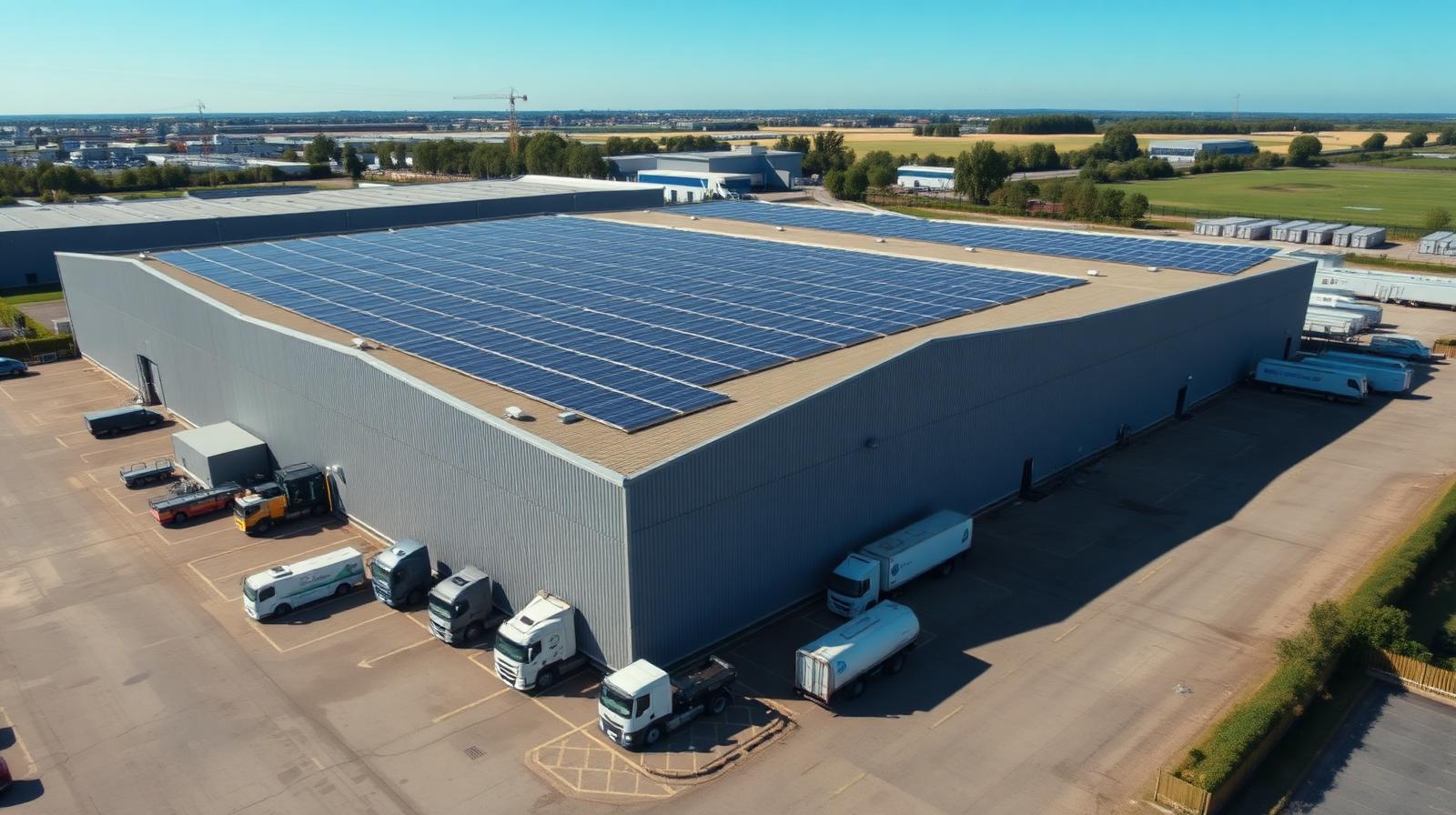
UK energy prices aren't returning to pre-2021 levels. For manufacturers, distributors, retailers and hospitality operators, electricity is now one of the largest controllable costs on the balance sheet. Commercial solar addresses that directly.
The financial case for commercial solar
Commercial tariffs run 22p–35p per kWh. A 50,000 kWh/year system replaces up to £17,500 of bought electricity annually. Here's how Alliant's recent installations have performed:
| Client | System | Annual saving | Payback / ROI |
|---|---|---|---|
| Shepherd Distribution | 108 panels + 62kW battery | £22,389/yr | 2.9 yrs / 38.7% |
| Tropical Ices | 168 panels (68.88 kWp) | £13,700/yr | 5.0 yrs / 24.0% |
| Pinder Brothers | 19.68 kWp flat-roof | £3,700/yr | 5.0 yrs / 22.3% |
These are real figures from real installations — not modelled estimates. Beyond bill savings, commercial solar also delivers SEG export income, improved EPC ratings, ESG reporting wins, and protection from future price rises.
Funding options for commercial solar
Power Purchase Agreement (PPA) — zero upfront cost
A third-party funder pays for the install. You buy the electricity it generates at a fixed rate below grid for 10–25 years. Immediate bill savings, no capital outlay. Best for businesses with high, consistent daytime use.
Full Expensing (100% tax relief)
Since April 2023, UK companies deduct 100% of qualifying plant and machinery — including commercial solar — from taxable profits in the year of installation. At 25% corporation tax, a £100,000 system effectively costs £75,000.
Asset finance and commercial loans
Repayments can be structured below the monthly energy saving, making the system cash-flow positive from day one. Alliant works with finance providers and can assist with applications.
Want a tailored business case?
Our surveyors aim to visit within five working days, with a detailed financial model — payback, ROI and funding routes.
How much does commercial solar cost?
| System size | Roof area | Installed cost | Annual generation |
|---|---|---|---|
| 10 kWp | ~60 m² | £12,000–£18,000 | ~8,500 kWh |
| 20 kWp | ~120 m² | £20,000–£30,000 | ~17,000 kWh |
| 50 kWp | ~300 m² | £40,000–£60,000 | ~42,500 kWh |
| 100 kWp | ~600 m² | £70,000–£100,000 | ~85,000 kWh |
Indicative for supply and installation. Flat-roof systems with ballast mounting carry a small premium. Systems needing structural reinforcement or specialist access are quoted individually.
Planning permission for commercial solar
- Systems up to 1MW on commercial, industrial or agricultural buildings typically qualify as Permitted Development.
- Listed buildings or some conservation areas need listed building consent or planning permission.
- Ground-mounted systems require planning regardless of size.
- Very large systems (50kWp+) may trigger DNO notification — we handle this.
Commercial solar by sector
Manufacturing and industrial
Production processes running 8–12 hours align closely with solar profiles, maximising self-consumption. Our Pinder Brothers (pewter) and Tropical Ices (food production) installations show the range.
Logistics and distribution
Large unshaded roof areas, consistent daytime use. Our Shepherd Distribution install (108 panels + 62kW battery) delivers £22,389/yr at 2.9-year payback.
Retail and hospitality
Dual impact on costs and customer perception. Supports ESG reporting and "renewable-powered" marketing.
Agricultural and farming
Large unshaded barns in high-sunshine areas. The Improving Farm Productivity Grant covers solar PV on agricultural properties.
Adding battery storage
For businesses on time-of-use or half-hourly tariffs, batteries significantly boost returns by charging overnight off-peak and discharging at peak. The Shepherd Distribution 62kW Sunsynk battery was central to its 2.9-year payback.
Alliant installs commercial batteries from GivEnergy, Puredrive and Sunsynk in 10kWh–100kWh+ configurations.
What to expect from a commercial installation
- Site survey (week 1–2): roof structure, meter arrangement, electrical infrastructure, shading, load profile.
- Quotation and design (week 2–3): system layout, projected generation, payback modelling, funding options.
- DNO application (weeks 3–6): we submit the grid-connection application.
- Installation (1–5 days): planned around your operational schedule.
- Commissioning and handover: full docs including MCS certificate for SEG.
Frequently asked questions
How long does a commercial solar system last?
Panels carry a 25-year performance guarantee and a 15-year product warranty as standard. Inverters: 5–10 year warranty; replacement after 10–15 years. Systems continue 30+ years.
Does commercial solar require business rates reassessment?
HMRC currently treats solar panels on business premises as plant and machinery — so rooftop solar does not normally trigger a rates reassessment. Confirm with your accountant.
Can we reclaim VAT?
applies until at least March 2027. After that, VAT-registered businesses can reclaim through their VAT return.
What if we move premises?
Panels are a fixed asset and remain with the property. They can be a selling point, transferable under some lease arrangements, or we'll design a new system for your next site.
How is the system monitored?
All installations include monitoring via the inverter platform (Solax, Solis, GivEnergy) or a third-party dashboard. Real-time generation, self-consumption and export, with fault alerts.
