
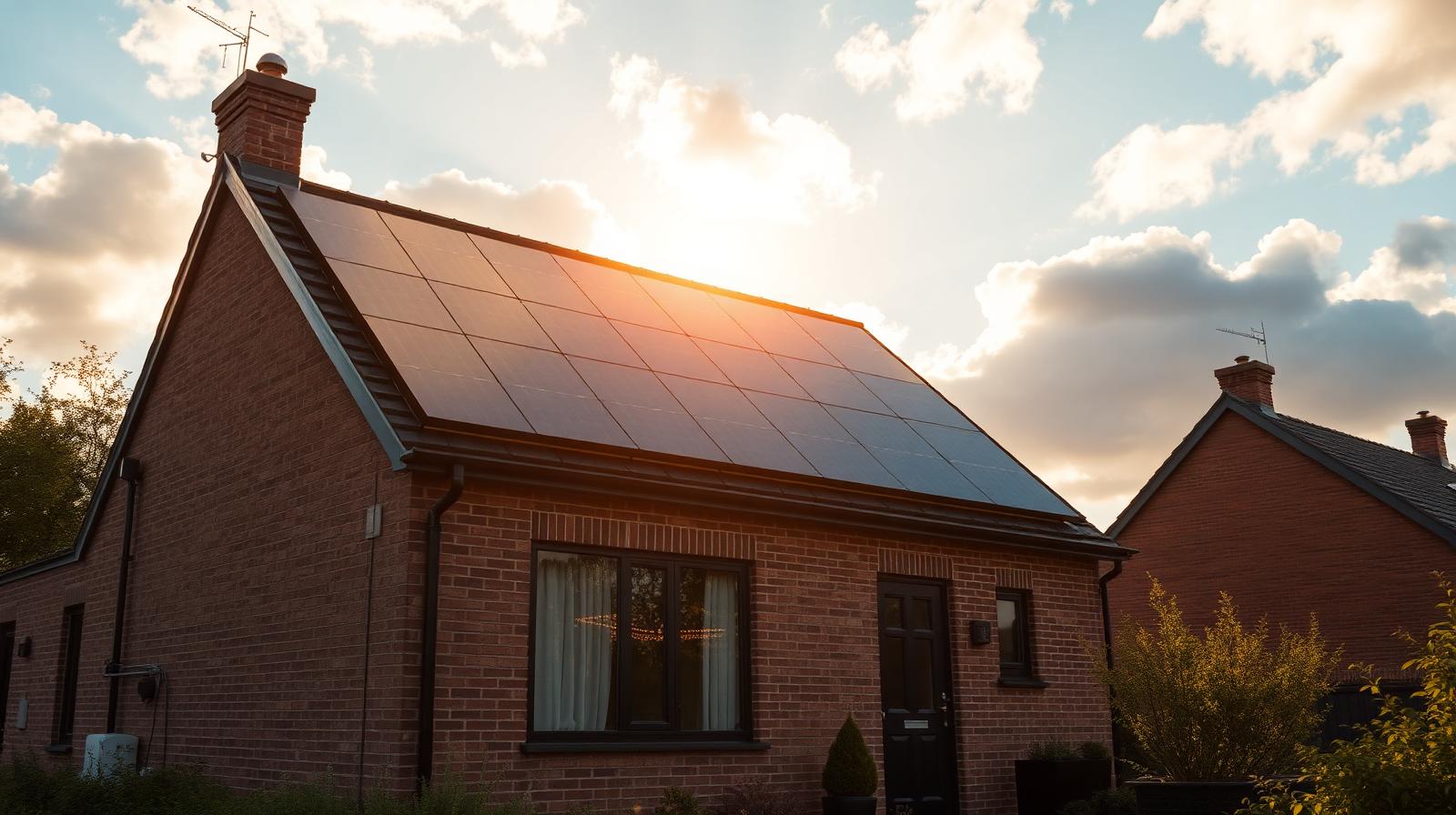
Solar panel installations across the UK have risen sharply. In 2026 the financial case is stronger than it has ever been: government grants of up to £12,000 are available to qualifying homeowners, VAT on solar is zero until March 2027, and most well-sized systems pay back inside a decade.
This guide is written by MCS-registered solar engineers who install solar systems across the UK.
How do solar panels work?
Solar panels contain photovoltaic (PV) cells — usually silicon — that convert sunlight into direct current (DC) electricity. An inverter converts that DC into the alternating current (AC) your appliances use.
Most systems include a generation meter showing what your panels produce. Add a battery and any power your home doesn't use immediately is stored for evening use rather than exported.
A typical 3.5kWp system (8–10 panels) covers roughly 60–70% of an average UK home's electricity consumption. Larger systems, or systems with battery storage, can cover much more.
Are solar panels worth it for UK homes?
Yes — for most UK homeowners. A solar system typically saves £700–£1,200 a year, pays for itself in 7–10 years, then generates effectively free electricity for a further 15–20.
| Factor | Typical figure |
|---|---|
| Average system size | 3.5kWp (8–10 panels) |
| Average installed cost | £6,000–£9,000 (before grants) |
| Annual bill saving | £700–£1,200 |
| Simple payback | 7–10 years |
| System lifespan | 25–30+ years |
| Years of 'free' electricity after payback | 15–20+ |
Solar delivers the strongest return when you use electricity during the day (home workers, families); your roof faces south, east or west with minimal shading; you plan to stay 7+ years; and you add battery storage to maximise self-consumption.
Note on energy prices
How much do solar panels cost in 2026?
| System size | Panels | Installed cost | Annual generation |
|---|---|---|---|
| 2.5 kWp | 6–7 | £4,500–£6,000 | ~2,100 kWh |
| 3.5 kWp | 8–10 | £6,000–£8,500 | ~2,900 kWh |
| 5 kWp | 12–14 | £8,000–£11,500 | ~4,250 kWh |
| 6.5 kWp | 16–18 | £10,000–£14,000 | ~5,500 kWh |
Prices cover supply and installation of panels, mounting, inverter, generation meter and MCS certification. Battery storage is quoted separately (typically £2,500–£6,000).
Get quotes from at least two MCS-registered installers. Quotes significantly below these ranges often mean lower-grade components or no proper certification.
Want a number for your roof?
We'll survey your property and return a written, MCS-compliant quote inside one working day.
Grants & VAT relief available in 2026
Warm Homes Plan
The flagship £13.2bn domestic energy scheme. Qualifying households access up to £12,000+ in grants and 0% interest loans toward solar, batteries and heat pumps. Aimed at lower-income owner-occupiers and private renters with EPC D or below.
ECO4
Under ECO4, energy companies fund free solar installations for eligible low-income households. Alliant checks eligibility and handles the full application — you don't approach energy companies directly.
solar
runs until March 2027. An £8,000 system today costs £1,600 less than it would under standard VAT. After March 2027, VAT may be reinstated.
Smart Export Guarantee (SEG)
Larger suppliers must pay you for surplus you export. Rates are typically 4p–15p per kWh. A typical 3.5kWp household earns £50–£150 a year. Add a battery and you keep more for yourself — usually more valuable.
Should you add battery storage?
A battery lets you hold the electricity your panels generate but your home doesn't immediately use. Without one, surplus is exported for a small SEG payment. With one, you use it yourself at 28p+ per kWh.
Most homes export 40–50% of their generation. Using that power yourself saves an additional £200–£400 a year on top of panel savings.
- You're out during the day when generation peaks
- You have an EV to charge in the evening
- Your usage is heavy mornings and evenings
Batteries add £2,500–£6,000. Combining solar and storage from the start is cheaper than retrofitting later. We install Tesla Powerwall, GivEnergy and Puredrive.
Solar panels and EV charging
A 3.5kWp system generates roughly 2,900 kWh per year — enough for 8,700–14,500 miles of EV driving from free solar power, depending on the car.
With a smart EV charger, your car automatically charges when your solar system is generating surplus. We install Easee, Hypervolt, myenergi Zappi, Ohme and Tesla Wall Connector — all compatible with solar diversion.
Do solar panels work in the UK climate?
Yes — and more effectively than most people expect. Panels generate from daylight, not direct sunlight. Output drops on overcast days (to 10–25% of peak), but UK annual sunshine is plenty for meaningful generation across the country.
The North West averages 1,200–1,400 sunshine hours per year. Germany — a far bigger solar market — gets comparable levels. The "British weather kills solar" argument is a myth. Rain even helps: it cleans the panels.
What does a solar installation involve?
For most homes, install is completed in a single day and is less disruptive than a kitchen renovation.
- Quote and system design (1–2 weeks): roof survey, shading analysis, sizing.
- DNO notification (2–4 weeks): we tell the Distribution Network Operator. Most domestic systems are auto-approved.
- Installation day (1–2 days): scaffold up, panels fitted, inverter installed, system tested.
- MCS certificate issued — required for SEG and grants. Keep it safe.
- SEG registration (1–2 weeks): we advise which suppliers offer the best rates.
How to choose an MCS-registered installer
61% of UK homeowners are worried about misleading solar offers. The single most important check: verify the installer holds MCS certification. Without it, you cannot register for SEG and may lose access to grants.
Look for MCS, NICEIC or NAPIT, TrustMark, and HIES membership. Alliant holds all of these.
Frequently asked questions
Do solar panels increase home value in the UK?
UK property data suggests homes with solar sell faster and command a small 3–5% premium, especially when reflected in the EPC rating. A higher EPC also broadens your mortgage lender pool.
Do I need planning permission?
Most residential installs fall under Permitted Development. Exceptions: listed buildings and some conservation areas. Alliant handles all DNO notifications.
How long do solar panels last?
Quality panels carry a 25-year performance guarantee. Well-maintained panels often produce for 30+ years, with around 0.5% efficiency loss per year.
Can solar power my whole home?
A large system plus battery can cover 80–100% of consumption. Most installs without storage cover 60–80%, with the grid as backup.
What happens during a power cut?
Panels shut off automatically by default to protect grid engineers. For backup, you need a battery with islanding — Tesla Powerwall and GivEnergy both offer this.
How often do panels need cleaning?
UK rain does most of the work. A professional clean once a year is usually enough; we recommend an MCS inspection every 3–5 years.
Can renters get solar?
Not without landlord permission. The Warm Homes Plan covers privately rented and social housing — your landlord may qualify for funded installation. Contact us.
