
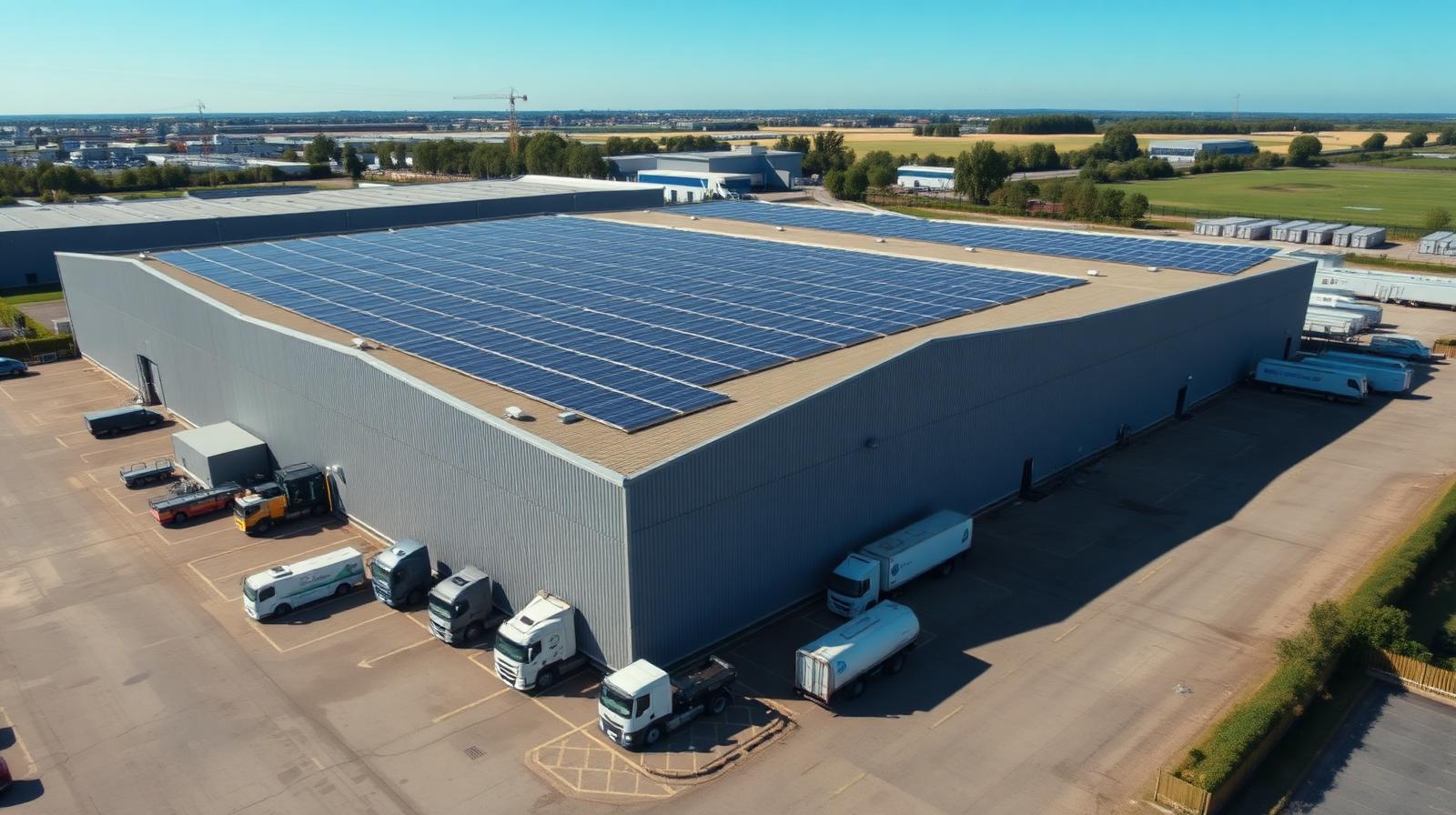
Commercial solar sizing starts with three questions: how much electricity you use and when, how much useable roof area you have, and your electricity rate and annual spend.
The three inputs that determine system size
The optimal system size balances these three. It generates enough to make a meaningful impact on your bill, it fits your roof without complex engineering, and it doesn't produce so much surplus that most of it is exported at low rates.
Understanding your consumption profile
A half-hourly data (HHD) download from your energy supplier shows exactly when you use electricity in 30-minute intervals across the year — the single most valuable piece of data for commercial solar design. You're entitled to it free of charge.
What you're looking for: how much electricity do you consume between 8am and 6pm on weekdays? That's your solar generation window. If 70% of consumption falls in those hours, a large system makes excellent sense. If 80% is overnight, solar without battery storage will have limited self-consumption.
Tip
Roof area and system capacity
As a rough guide, 1 kWp of commercial solar requires approximately 5–7 m² of roof area.
| System size | Approx. roof area | Annual generation (UK avg) | Best suited to |
|---|---|---|---|
| 30 kWp | ~180–210 m² | ~27,000 kWh/yr | Small commercial, SME offices, small retail |
| 50 kWp | ~300–350 m² | ~45,000 kWh/yr | Medium commercial, small manufacturing |
| 100 kWp | ~600–700 m² | ~90,000 kWh/yr | Mid-size manufacturing, large retail, logistics |
| 200 kWp | ~1,200–1,400 m² | ~180,000 kWh/yr | Large industrial, distribution depots |
| 500 kWp | ~3,000–3,500 m² | ~450,000 kWh/yr | Very large industrial, agri-commercial |
Matching system size to electricity consumption
The general rule: size the system to cover 80–100% of your daytime electricity consumption. Oversizing means exporting at low SEG rates (5–10p/kWh) rather than displacing grid electricity (25–35p/kWh). Undersizing leaves savings on the table — incremental panel cost is low at install time.
Example: a manufacturer using 350,000 kWh/year with 250,000 kWh consumed 7am–7pm. A 200kWp system generating ~180,000 kWh covers 72% of daytime consumption — reasonable sizing. 250kWp would approach daytime consumption with minimal oversupply.
Get a properly sized commercial proposal
Free site survey and HHD-based modelling.
DNO constraints
Your Distribution Network Operator may limit system size. For systems above 50kWp (sometimes lower), a G99 application is required and the DNO assesses whether your existing grid connection can accommodate export capacity. Options if export is constrained: reduce size, add battery to limit export, or apply for a connection upgrade. We handle DNO applications for all commercial installations.
Why commercial surveys matter
Commercial buildings vary enormously in roof condition, structural capacity, aspect, shading, cable routing complexity and electrical infrastructure. Satellite imagery gives a useful first approximation; a proper structural and electrical survey is essential before committing.
Frequently asked questions
Can we install solar on a flat industrial roof?
Yes — flat or low-pitch industrial roofs are among the most common commercial solar installations. Panels are mounted on angled frames using ballasted systems that avoid roof penetrations where possible.
What if our roof faces the wrong direction?
On flat roofs, orientation is less critical — panels can be angled in any direction using the mounting frame. On pitched roofs, east-west orientation loses around 15–20% vs south but is still viable, particularly for larger systems.
How long does a commercial survey take?
Typically 1–3 hours on site for a medium-sized installation. We assess roof condition, structural suitability, panel layout, cable routing and electrical infrastructure. The survey is free and without obligation.
