
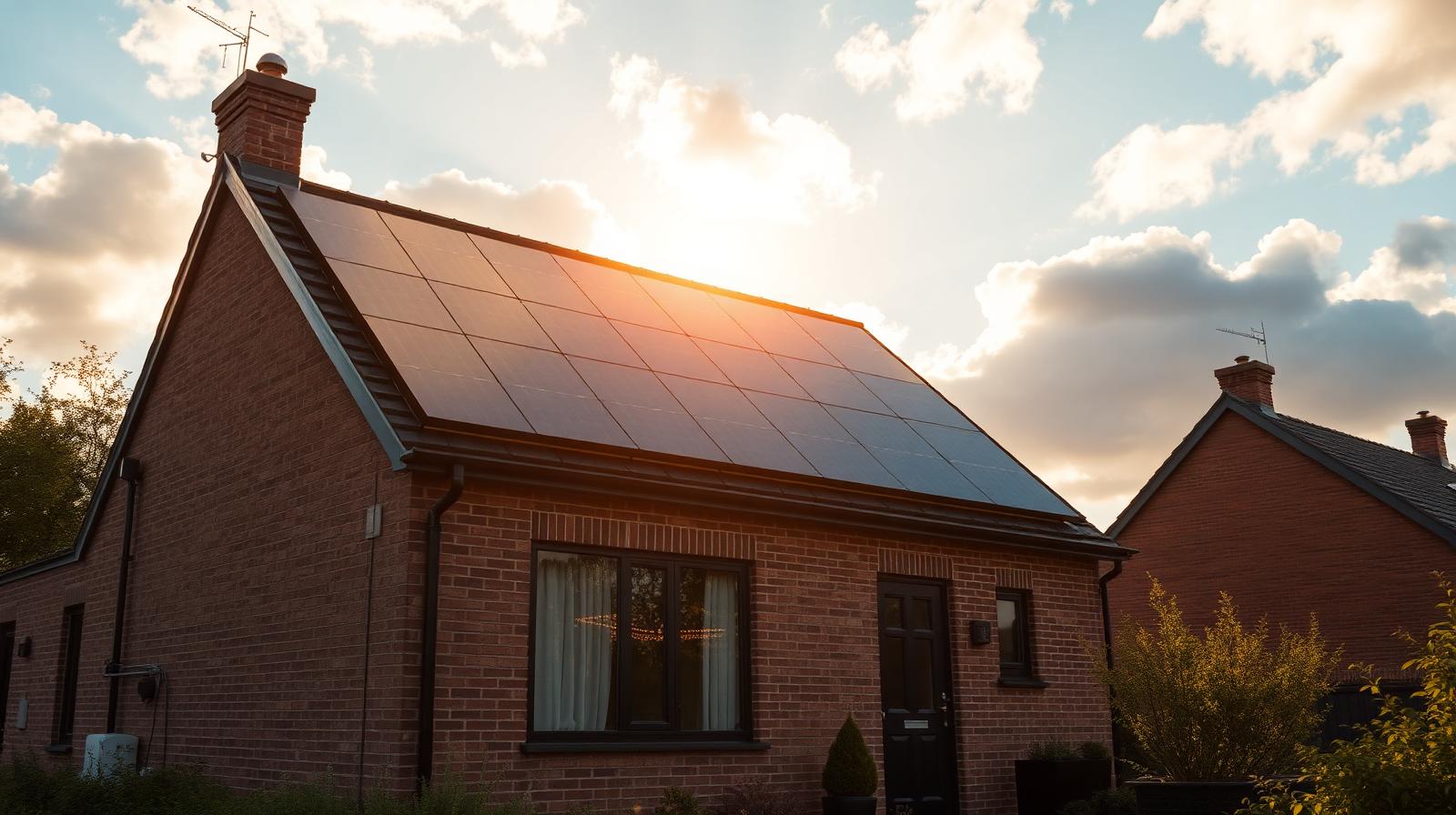
This guide walks you through the calculation — from your annual kWh usage to the right number of panels and battery size for your home.
Start with your electricity usage
The starting point is your annual electricity consumption in kWh. You'll find this on your electricity bill. The UK average is around 3,500 kWh/year for a typical household — but actual usage varies considerably:
| Household type | Typical annual usage |
|---|---|
| 1–2 bed flat or small home | 1,500–2,200 kWh/yr |
| 3-bed semi (2 adults) | 2,800–3,800 kWh/yr |
| 4-bed detached (family) | 3,500–5,000 kWh/yr |
| Home with EV (charging at home) | Add 2,000–4,000 kWh/yr |
| Home with air source heat pump | Add 2,500–5,000 kWh/yr |
If you have an EV or are planning to get a heat pump, your electricity demand is significantly higher — and sizing your solar system to cover that demand makes the economics much stronger.
How much does a solar panel generate in the UK?
A single 465W panel in the UK generates approximately 390–430 kWh per year, depending on roof orientation, pitch and location. Here's a quick reference:
| Panel count | System size (kWp) | Est. annual generation (South-facing) |
|---|---|---|
| 6 panels | 2.79 kWp | 2,200–2,600 kWh/yr |
| 8 panels | 3.72 kWp | 2,900–3,500 kWh/yr |
| 10 panels | 4.65 kWp | 3,600–4,300 kWh/yr |
| 12 panels | 5.58 kWp | 4,400–5,100 kWh/yr |
| 16 panels | 7.44 kWp | 5,800–6,800 kWh/yr |
Note
The self-consumption question
Generating 3,500 kWh per year doesn't mean you use all 3,500 kWh. Without a battery, homes typically self-consume 30–40% of generation. The rest is exported to the grid at SEG rates (4–15p/kWh) while you continue buying from the grid at 24–28p/kWh.
A battery changes this. With a 5.76 kWh battery, self-consumption typically rises to 60–75%. With an 11 kWh battery and smart tariff integration, you can exceed 80% in summer. The optimal battery size depends on your daily evening usage — there's no point in a 20 kWh battery if you only use 3 kWh after dark.
A simple sizing calculation
Here's a worked example for a 3-bed semi using 3,500 kWh/year:
- Step 1 — Target generation: match your usage. Aim for 3,000–4,000 kWh/yr from the panels.
- Step 2 — Panel count: 3,500 kWh ÷ 430 kWh/panel = approximately 8 panels (3.72 kWp).
- Step 3 — Battery size: evening demand is typically 1.5–3 kWh. A 5.76 kWh battery covers most households' evening use.
- Step 4 — Reality check: do you have 8 panels' worth of useable, non-shaded roof facing south/south-west? A west-facing roof might need 10 panels to achieve equivalent generation.
EV owners
Roof space: how much do you need?
A standard 465W panel is approximately 1.75m × 1.13m. That's around 2 m² per panel. Eight panels need roughly 16 m² of clear, unobstructed roof space — feasible on most 3-bed semis with a south or south-west facing slope.
Roof obstructions (skylights, chimneys, vents) reduce useable space. Our pre-installation survey confirms what's available and designs the array layout accordingly.
Get a site-specific projection
We size on your actual usage — not on maximising hardware sold.
Our standard packages — and why they're sized the way they are
Our three packages reflect the most common domestic requirements:
- Package 3 (6 panels, 5.76 kWh battery, £5,999): right for homes using under 3,000 kWh/year or with limited roof space.
- Package 2 (8 panels, 5.76 kWh battery, £6,999): best match for a typical 3–4 bed home using 3,000–4,000 kWh/year. Our most popular.
- Package 1 (12 panels, 11 kWh battery, £9,000): homes using 4,000+ kWh/year, EV owners, or anyone looking to maximise generation and self-consumption.
If your situation doesn't fit neatly into one of these, we'll specify a custom system.
Frequently asked questions
Can I have too many solar panels?
Technically yes — if you generate significantly more than you can use or store, the excess is exported at low SEG rates. Oversizing also means a higher upfront cost without proportionate savings. A properly sized system generates slightly less than annual demand, with a battery covering the gap.
What if I can't fit enough panels for my usage?
Install what fits and accept that solar covers a portion of your demand rather than all of it. Even a partial-coverage system is valuable. Alternatively, higher-wattage panels (500W+) in the same footprint will generate more.
Does it matter which direction my roof faces?
Yes, but east and west-facing roofs are still viable — they generate around 15–20% less than a south-facing equivalent. Many installations use both sides of a pitched roof (east + west), which provides more consistent generation through the day than a single south-facing array.
