
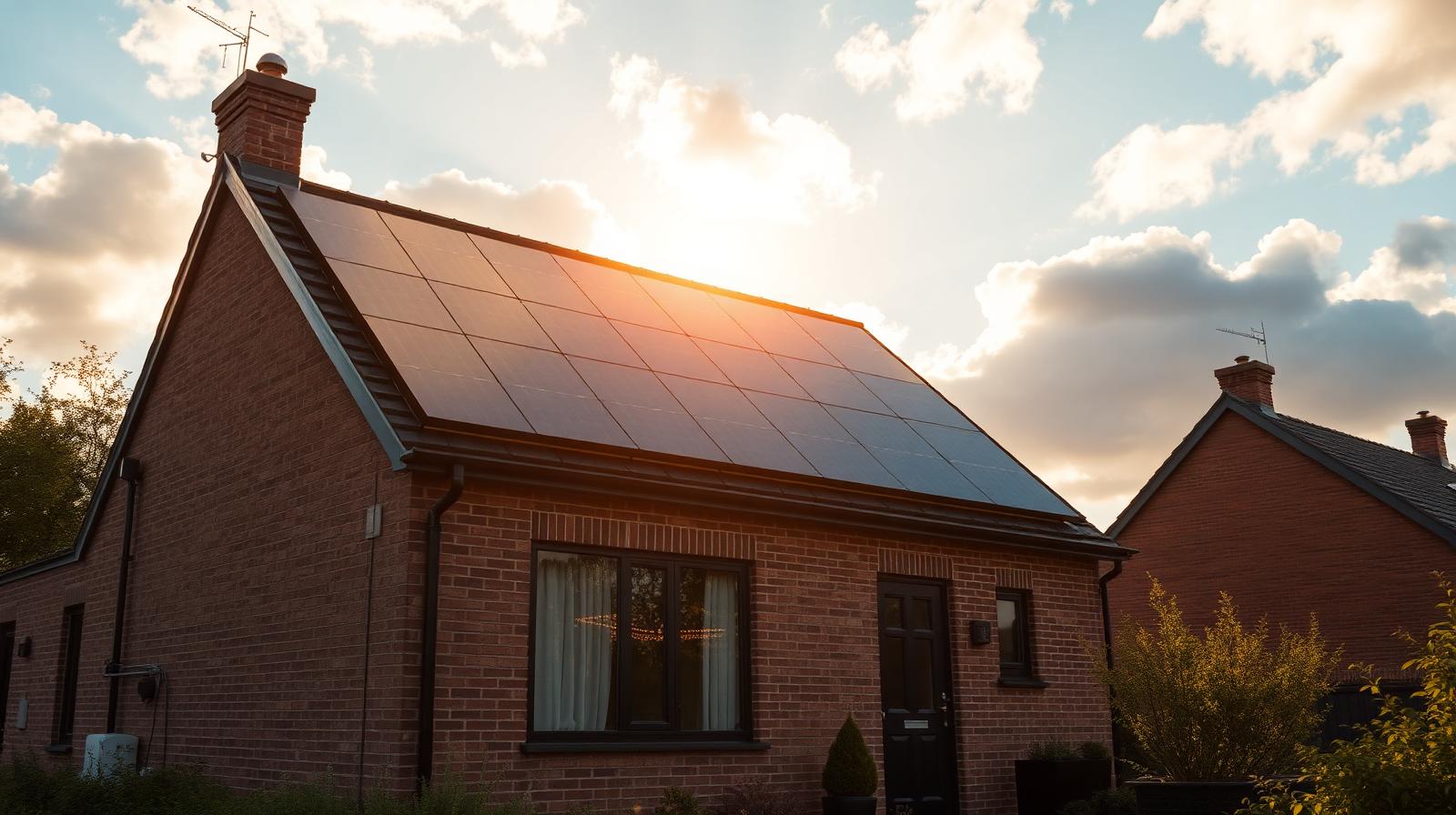
We're a solar installer, so you might expect us to tell you solar is always brilliant. We won't. There are homes where the payback period is too long to make financial sense right now, and we'd rather tell you that than install something that doesn't deliver. What we can do is show you the real numbers — from real installations — so you can make your own judgment.
The numbers: what does solar actually save?
A typical 3–4 bedroom UK home uses around 3,500 kWh of electricity per year. A well-sized solar system — 8 panels at 3.72 kWp — generates approximately 3,000–3,500 kWh per year in the UK, depending on location and orientation.
You won't use all of that generation yourself. Without a battery, homes typically self-consume around 30–40% of what their panels generate — the rest is exported to the grid. With a battery, self-consumption rises to 60–80%, and that's where the savings get more interesting.
| Setup | Est. annual saving | Typical payback |
|---|---|---|
| Solar only (no battery) | £350–£500/yr | 10–13 years |
| Solar + battery (5.76 kWh) | £650–£850/yr | 8–10 years |
| Solar + battery + smart tariff | £800–£1,100/yr | 6–8 years |
| Solar + battery + smart tariff + EV | £1,200–£1,800/yr | 4–6 years |
Note
What makes the biggest difference to whether it's worth it
Roof orientation is the first factor. South-facing roofs generate the most — typically 10–15% more than east or west-facing equivalents. North-facing roofs can still work, but with a longer payback period. If your main roof is north-facing, we'll tell you.
How much electricity you use matters more than most people expect. If you're out of the house all day and only use power in the evenings, you'll export a high proportion of your generation rather than using it directly. A battery fixes this — but adds cost. If you work from home, run a home office, or have an EV, your self-consumption naturally increases.
Your energy tariff can shift the numbers significantly. On a standard variable tariff at 24p/kWh, solar is worth it. On an overnight smart tariff like Octopus Intelligent — which lets you charge a battery at 7–10p/kWh overnight and use it during the day — the combination of solar, battery and tariff can cut your electricity bill by 70–80%.
When is solar NOT worth it?
There are scenarios where we'd advise against installing right now:
- Heavily shaded roof: If your roof is overshadowed by trees or neighbouring buildings for most of the day, generation will be too low to justify the cost. Micro-inverters can partially mitigate shading, but there's a limit.
- Roof needing replacement: If your roof covering is at end of life, replace it first. Installing panels on a roof that needs work in 5 years means temporary removal and reinstallation — additional cost that eats into your returns.
- Very low electricity use: If your annual electricity bill is below £600, the payback period stretches considerably. Solar is best suited to households spending £900+ per year on electricity.
- Planning to sell within 3 years: Solar does add to house value, but probably not enough in that timeframe to recoup the full installation cost. For longer-term owners, it's a different calculation.
What solar can't do (and what it can)
Solar panels don't generate electricity at night. A battery stores daytime generation for evening use, but if you have long periods of low generation (extended cloudy winters), you'll still draw from the grid. Solar + battery reduces your grid dependence — it doesn't eliminate it.
Solar also doesn't protect you from grid price rises on its own. What it does is reduce the volume of electricity you buy from the grid, so rising prices affect you less. The smaller your grid import, the less exposed you are to tariff increases.
Key insight
Get a tailored projection in one working day
A free, site-specific quote from a renewable energy engineer — not a salesperson.
The 2026 landscape: why now is still a good time
Panel prices have fallen around 90% over the past decade and stabilised. The current sweet spot — good-quality panels with a 10+ year inverter warranty and a battery — costs £6,000–£9,000 installed. That's competitive.
The Smart Export Guarantee means you're legally entitled to be paid for surplus electricity you export. The solar installations (introduced in April 2022) saves homeowners approximately £1,200–£1,800 on a typical system versus the 20% rate. That rate is currently legislated through March 2027.
For households in lower-income brackets, Warm Homes Plan funding can cover solar, battery storage and insulation measures. Eligibility is broader than many people assume — it's worth checking.
The verdict
For a homeowner with a south or south-west facing roof, electricity spend above £1,000/year, and an appetite to add a battery and a smart tariff, solar is very likely worth it in 2026. The payback is real, the technology is mature, and the SEG provides a guaranteed income on exports.
For homes with awkward roofs, heavy shading, or very low electricity use, the answer is less clear — and that's exactly why it's worth getting a specific projection rather than relying on generic estimates.
Frequently asked questions
Do solar panels work on cloudy days?
Yes — panels generate electricity from daylight, not direct sunlight. The UK's average 1,100–1,350 peak sun hours per year is sufficient for a well-performing system. Output is reduced on very overcast days, but generation continues.
How long do solar panels last?
Most quality panels carry a 25–30 year performance warranty. Output degrades slowly over time — typically 0.4–0.5% per year. A panel generating 465W today will generate approximately 445W in year 10. The system pays for itself several times over in that lifespan.
Will solar panels save me money straight away?
From the day the system is commissioned, your electricity bill will reduce. The 'payback' figure refers to when cumulative savings equal the upfront cost — not when savings start. Day-one savings are immediate.
What's the best way to make solar more worth it?
The three biggest levers are: (1) add a battery to increase self-consumption, (2) switch to a smart overnight tariff to charge the battery cheaply, and (3) get an EV to use solar generation for transport as well as the home.
